
Planning: guide
Aftercare guide: caring for your skin after Botox, fillers, lasers, peels and microneedling
What does good aftercare involve?
Aftercare is what you do in the hours, days and weeks after a treatment to help it heal well and lower the risk of side effects. It differs by treatment: after Botox you avoid rubbing the area, after filler you hold off on exercise until the next day, and after lasers, peels and microneedling you protect healing skin from the sun.[1][3][7][8][9] Your own provider's instructions always come first.

Aftercare key points
| Neurotoxins (Botox and similar) | Do not rub or massage the area. Hold off on strenuous activity: guidance ranges from two hours to 24 hours.[1][2] |
|---|---|
| Dermal fillers | Wait until the next day to exercise, stay out of the sun and avoid touching the area for three days unless told to massage it.[3] |
| Laser resurfacing | Keep the skin clean and covered with ointment as directed while it heals, usually 5 to 21 days, then use sunscreen every day.[6][7] |
| Chemical peels | Healing ranges from 1 to 7 days for a light peel to 14 to 21 days for a deep peel; use sunscreen daily once healed.[8] |
| Microneedling | Downtime is minimal; wait 24 hours before applying makeup and protect your skin from the sun.[9] |
| Microdermabrasion-type facials | No downtime; use moisturizer and sun protection as directed.[10] |
| For every treatment | Follow your own provider's instructions, and call them about any warning sign listed below.[4][8][9] |
Aftercare basics that apply to most treatments
- Follow your provider's plan. Recovery differs by person and by product, so discuss your own plan before treatment.[4] Following aftercare instructions also lowers the risk of side effects.[9]
- Protect your skin from the sun. After laser resurfacing, peels, microneedling and microdermabrasion, daily sun protection helps you heal and maintain the improvement.[7][8][9][10]
- Skip tanning beds. Avoid indoor tanning after fillers and after chemical peels.[3][8]
- Do not pick, scratch or rub. Picking at crusts after laser resurfacing can cause scarring, and rubbing or scratching skin after a chemical peel can cause infection.[7][8]
- Keep healing skin moist when told to. After a peel, skin that dries and cracks can scar, so use the moisturizer as directed.[8]
After neurotoxins and dermal fillers
Botox and other neurotoxins
This applies to Botox and other botulinum toxin products such as Dysport, Xeomin, Daxxify and Jeuveau. Most people return to everyday activities right away.[1]
- Do not rub or massage the treated areas, which helps keep the toxin from spreading where it is not wanted. Apply makeup gently without pressing or rubbing it in.[1]
- Avoid rubbing or pressing on the treated area for the first few hours, and stay upright, not lying down, for three to four hours after treatment.[2]
- Hold off on strenuous activity. Wait at least two hours before lifting heavy items, working out or anything that raises your heart rate, and follow your own provider's instructions.[1][2]
- Expect minor marks. Swelling, redness, soreness or bruising can occur, and bruising lasts about a week.[1]
Dermal fillers
This applies to dermal fillers in any area, including lips, cheeks and under the eyes. Most people return to everyday activities after leaving the office, and your dermatologist may ice the area for 15 to 20 minutes before you go.[3]
- Wait until the next day to exercise or do other strenuous activity.[3] Avoiding intense activity for the first 24 to 48 hours is generally recommended to limit swelling and bruising.[4]
- Stay out of the sun and avoid tanning beds.[3]
- Avoid touching the area for three days, unless your provider tells you to massage it. Poly-L-lactic acid (Sculptra) is the exception: you gently massage the area for about 5 minutes several times a day for 1 to 2 weeks if your dermatologist tells you to.[3]
- Expect some swelling or bruising. Redness, swelling, tenderness and occasional bruising tend to clear within 7 to 14 days. Most early reactions improve within hours to a few days with icing and massage.[3][4]
After lasers, peels and microneedling
Laser resurfacing
This applies to resurfacing lasers such as CO2, erbium and fractional lasers like Fraxel. For Laser Genesis and pico lasers, see each guide.
- Keep it covered and clean. A dressing may be applied at first. Then you clean the area as directed, for example with saline soaks, and keep it moist with an ointment such as petrolatum until any crusting clears.[6][7]
- Expect a sunburn-like phase. Most treated skin feels like a mild sunburn, with redness, swelling, itching or stinging. After some treatments skin can be raw and ooze, and it usually dries and peels about five days to a week later.[7]
- Give it time to heal. Healing time depends on the laser and how deeply the skin was treated. Erbium-treated skin typically resurfaces in about five days, and CO2-treated skin in about eight days.[6]
- Pinkness after healing. Redness can last from a few weeks to several months, depending on how aggressive the treatment was.[6]
- Sunscreen every day after healing, and restart retinoid or glycolic acid products only when your physician says, around six weeks after treatment.[7]
Chemical peels
Aftercare for chemical peels depends on the depth of the peel.[8]
Swipe sideways to see all three peel depths.
| Light (lunchtime) peel | Medium peel | Deep peel | |
|---|---|---|---|
| Healing time | 1 to 7 days[8] | 7 to 14 days[8] | 14 to 21 days[8] |
| At-home care | Lotion or cream until healed, then daily sunscreen[8] | Daily soaks with ointment, an antiviral medicine for 10 to 14 days, and no sun until healed[8] | 4 to 6 soaks a day with ointment, an antiviral medicine for 10 to 14 days, and no sun for 3 to 6 months[8] |
| Makeup | Usually right away or the next day[8] | Camouflaging makeup after 5 to 7 days[8] | Not for at least 14 days[8] |
After any peel, contact your dermatologist if your skin burns, itches or swells, avoid indoor tanning, and apply sunscreen every day once healed.[8]
Microneedling
- Minimal downtime. You can return to work or school right away. Redness or darker shades, a sunburned feeling, burning or swelling usually fade in a few days to a week.[9]
- Wait 24 hours before makeup. Your dermatologist may recommend a soothing aftercare cream.[9]
- Protect your skin from the sun and do not smoke, which helps slow the loss of collagen.[9]
- Follow your skin care routine, which may include pausing retinoids such as retinol and tretinoin for a few days.[9]
For radiofrequency microneedling, see the Morpheus8 guide.
After facials
- Microdermabrasion and HydraFacial-type treatments. There is no downtime, though skin may be pink or slightly swollen for a day or two. Use the moisturizer and skin care plan you are given, including sun protection.[10]
- PRP facials. There is little to no downtime; pain, bruising and swelling tend to go away within a few days.[11]
When to call your provider
Get help right away
Call your provider soon about
- Burning, itching or swelling after a chemical peel[8]
- Signs of infection after laser resurfacing; bacterial infection is a listed complication[7]
- Filler side effects that appear weeks, months or years after treatment[5]
Questions to ask before treatment are in our guide to choosing a provider.
Frequently asked questions about aftercare
How long should I wait to exercise after Botox?
Guidance ranges from waiting two hours before strenuous activity to avoiding physical exertion for 24 hours. Follow your own provider's advice.[1][2]
Can I lie down after Botox?
Stay upright for three to four hours after treatment to reduce redness, swelling or bruising.[2]
When can I exercise after filler?
Wait until the next day.[3] Avoiding intense activity for 24 to 48 hours is generally recommended.[4]
Should I massage my filler?
Avoid touching the treated area for three days unless your provider tells you to massage it. Poly-L-lactic acid is the main exception.[3]
How long does it take to heal after laser resurfacing?
Generally 5 to 21 days, depending on the laser and what was treated. Pinkness can last two to three months or longer.[6]
When can I wear makeup after a chemical peel?
Usually right away for a light peel, after 5 to 7 days for a medium peel, and not for at least 14 days after a deep peel.[8]
When can I wear makeup after microneedling?
Wait 24 hours before applying makeup.[9]
SkinSync AI: Aesthetic Care
Plan your next step in the app.
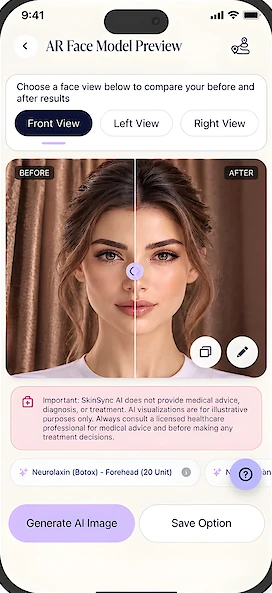
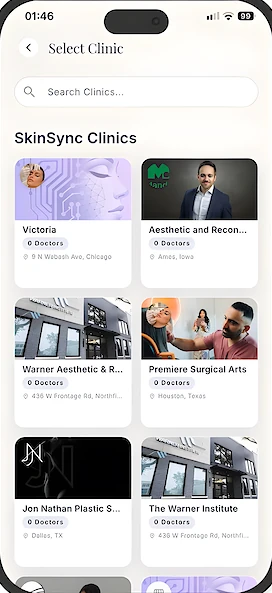
Aftercare itself is not part of the SkinSync AI simulator. In the app you can see simulations of neurotoxin and dermal filler treatments today (laser and energy-based treatments are coming soon), find participating clinics and providers with their availability and pricing, and book a consultation.
- Scan your face and see an illustrative neurotoxin or dermal filler simulation from the front and both sides
- Find participating clinics and providers, with availability and pricing
- Book a consultation, in person or virtual, or a treatment in the app
- Save your scans and get reminders and aftercare guidance


Simulations are illustrative and do not predict results. The app does not give medical advice; a licensed provider determines appropriate treatment.
Sources
Every medical fact on this page is linked to one of these sources. Reviewed October 30, 2026.
- American Academy of Dermatology: Botulinum toxin therapy, FAQs
- Clinical, Cosmetic and Investigational Dermatology: Botulinum toxin (Botox) A for reducing the appearance of facial wrinkles: a literature review of clinical use and pharmacological aspect (2019); Toxins: Are Post-Care Recommendations Following Upper-Face Botulinum Toxin Treatment Scientifically Necessary? A Retrospective Study Based on 5000 Patients (2025)
- American Academy of Dermatology: Fillers, FAQs
- American Society of Plastic Surgeons: Dermal fillers recovery
- U.S. Food and Drug Administration: Dermal filler do's and don'ts for wrinkles, lips and more
- StatPearls (NCBI Bookshelf): Ablative Laser Resurfacing (2023)
- American Society of Plastic Surgeons: Laser skin resurfacing recovery
- American Academy of Dermatology: Chemical peels, FAQs
- American Academy of Dermatology: Microneedling can fade scars, wrinkles and stretch marks
- American Academy of Dermatology: Microdermabrasion, FAQs
- American Academy of Dermatology: Is platelet-rich plasma the secret to younger-looking skin?
Related guides
Botox, Dysport, Xeomin, Daxxify, Jeuveau, Sculptra, Fraxel, Morpheus8 and HydraFacial are trademarks of their respective owners. SkinSync AI is not affiliated with or endorsed by these companies.