
Dermal fillers: treatment guide
Cheek filler: types, results, side effects and cost
What is cheek filler?
Cheek filler is a nonsurgical treatment in which a provider injects dermal filler around and above the cheekbones to give the cheeks a fuller, more defined look.[3] Cheek augmentation is an FDA-approved use of dermal fillers, and specific hyaluronic acid fillers are approved to correct age-related volume loss in the midface in adults over 21.[1][4][5] Depending on the filler, results can last a year or more.[3]

Cheek filler quick facts
| What it is | Dermal filler injected around and above the cheekbones[3] |
|---|---|
| What it treats | Cheek volume and cheekbone definition, plus wrinkles and lines[3]; FDA-approved uses include cheek augmentation for age-related midface volume loss[4][5] |
| Common filler types | Hyaluronic acid (most common), calcium hydroxylapatite, poly-L-lactic acid and PMMA[3] |
| How long it lasts | About a year for hyaluronic acid, about 15 months for calcium hydroxylapatite and two years or more for poly-L-lactic acid[3] |
| Treatment time | About 15 to 30 minutes[3] |
| Results timeline | Some results right away; full results can take several days and sometimes months[3] |
| Downtime | Usually little or none; your provider may suggest avoiding strenuous exercise for 24 to 48 hours[3] |
| Cost | Varies by clinic and area. Depends on the type of filler, the provider, the time the treatment takes and the location.[7] |
| Insurance | Not covered by health insurance[7] |
How cheek filler works
As we age, the face loses fat under the skin and the skin stretches, which reduces fullness in areas like the cheeks.[8] Cheek filler is a dermal filler injected beneath the skin of the cheeks to restore that volume.[3]
People choose cheek filler to add volume to the cheeks and soften wrinkles and lines.[3] Your provider may inject small amounts in several areas of the cheek.[3]
Products approved for the cheeks are placed deep. For example, the FDA approved Juvederm Voluma XC for deep injection, under the skin and/or on the surface of the bone, for cheek augmentation to correct age-related volume loss in the midface, and Restylane Lyft with Lidocaine for cheek augmentation and correction of age-related midface contour deficiencies, both in adults over 21.[4][5]
Fillers are not a substitute for surgery. For some people a facelift may be the best approach, and fillers cannot achieve the same results, though they may help delay the time when a facelift becomes appropriate.[8]
What to expect, step by step
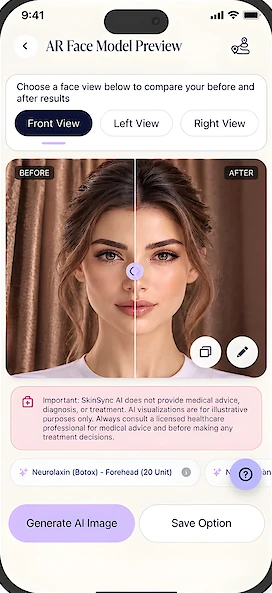
- Before your consultation: preview it in the appIf you like, scan your face in the SkinSync AI app and look at an illustrative cheek filler simulation, so you can show your provider what you have in mind. A simulation does not predict your result, and your provider decides what is appropriate for you.
- ConsultationYour provider looks at your face, asks about your goals and suggests the most suitable filler. Tell them about allergies, a bleeding disorder, any skin that is inflamed or infected, medical conditions, the medicines and supplements you take, and previous fillers.[3]
- PreparationYour provider may mark where the injections will go and take photos. Your skin is cleaned and may be numbed with a cold instrument, a numbing ointment or an injection of local anesthetic. Some fillers already contain a numbing agent.[3]
- InjectionsSmall amounts of filler are injected beneath the skin. You may feel some discomfort, but the injections are usually well tolerated. The procedure usually takes less than an hour.[3]
- Right afterYour provider may apply cool packs. For a few days you may have bruising, discomfort and swelling.[3]
- ResultsWith most cheek fillers you see results right away. Poly-L-lactic acid results can take two to three weeks to appear.[3][6]
- MaintenanceCheek filler is not permanent. With a temporary filler, you can usually be treated again when signs of aging reappear.[3][6]
Side effects and who should avoid cheek filler
Common side effects
Most side effects of cheek filler are temporary.[3] Possible side effects include:
- Bruising, swelling, pain and tenderness[3]
- Redness, itching or rash[3]
- Small bumps at the injection site[3]
- Nodules (lumps under the skin)[3]
These usually go away within a few days to weeks. Filler can also move to another part of the face; if that happens, it may need to be removed or reduced, sometimes with injections.[3] Less often, people have an allergic reaction, infection, leakage of the filler, or tissue damage.[3]
Serious but rare: filler in a blood vessel
Very rarely, filler injected into a blood vessel can cause permanent damage, including injury to the artery or vein, tissue death and vision loss.[3] The FDA also lists stroke among the complications.[1]
Get medical help right away for unusual pain, vision changes, skin near the injection that turns white, gray or blue, or signs of a stroke during or shortly after treatment.[1]
Who should avoid cheek filler or talk to a provider first
- Pregnancy or breastfeeding[1][3]
- Under 22. Fillers are approved for adults over 21.[1][4][5]
- Allergies to substances in some fillers, a history of severe allergies or anaphylaxis, or allergy to lidocaine, which some cheek fillers contain[3][4]
- A bleeding disorder[1][3]
- Certain medical conditions; tell your provider about any you have[3]
- An active infection, especially at or near the injection site[3]
- Certain skin diseases or inflamed, infected skin at the injection site[1][3]
Cheek filler aftercare
- Follow your provider's instructions on when you can use makeup and lotions on the treated area.[3]
- Avoid touching the injection areas for a few days unless your provider tells you otherwise.[3]
- Follow your provider's instructions for the first few days so you do not disturb the filler.[3]
- Follow your provider's advice on sun exposure and smoking while you heal.[3]
- If your provider suggests it, avoid strenuous exercise for a short time.[3]
- Poly-L-lactic acid: your provider may ask you to massage the area for about 5 minutes several times a day for 1 to 2 weeks.[6]
- Call your provider if unevenness, bruising, redness or swelling does not go away, or if you have signs of infection. Call 911 for signs of a severe allergic reaction, such as shortness of breath.[3]
Hyaluronic acid vs other cheek fillers
Several filler materials are used in the cheeks, including hyaluronic acid.[3] Your provider recommends a type based on your goals.[3]
Swipe sideways to see all four types.
| Hyaluronic acid | Calcium hydroxylapatite | Poly-L-lactic acid | PMMA | |
|---|---|---|---|---|
| What it is | A sugar found naturally in the skin, used as a gel that binds water[2] | Mineral particles, like those in bone, in a gel[2] | A biodegradable man-made polymer that helps the body make its own collagen[2][3] | Tiny beads the body does not absorb, in a gel with cow (bovine) collagen[2] |
| Use in the cheeks | Adds volume and keeps skin hydrated[3] | Adds fullness to the cheekbones and smooths deeper lines[3] | Usually used for deep wrinkles in the cheeks[3] | Adds firmness and structure[3] |
| How long it lasts in the cheeks | About one year[3] | About 15 months[3] | Two years or more[3] | Can last for years; more than one treatment may be needed[3] |
| When results show | Immediately[6] | Immediately[6] | Gradually, over about two to three weeks[3][6] | Immediately[6] |
| Can it be dissolved? | Yes, with the enzyme hyaluronidase[9] | Removal may be difficult or impossible[1] | Removal may be difficult or impossible[1] | Permanent; removal may be difficult or impossible[1] |
| Examples | Juvederm, Restylane[3] | Radiesse[3] | Sculptra[3] | Bellafill[3] |
Another option is fat grafting, in which fat from another part of your body is injected into the cheeks.[3]
Which filler suits you is a decision to make with a licensed provider.
Frequently asked questions about cheek filler
How long does cheek filler last?
It depends on the filler. Expect about one year for hyaluronic acid, about 15 months for calcium hydroxylapatite and two years or more for poly-L-lactic acid. PMMA can last for years.[3]
What is the best filler for cheeks?
There is no single best filler; your provider recommends one based on your goals. Hyaluronic acid is the most common, and specific hyaluronic acid products, such as Juvederm Voluma XC and Restylane Lyft with Lidocaine, are FDA approved for cheek augmentation.[3][4][5]
Is cheek filler FDA approved?
Yes. Cheek augmentation is an FDA-approved use of dermal fillers, and approval applies to specific products for specific areas. Ask which product your provider will use and read its patient labeling.[1][4][5]
Does cheek filler hurt?
Most people feel a small pinch or sting. Your skin may be numbed first, and some fillers contain a numbing agent.[3]
When will I see cheek filler results?
With most cheek fillers you see some results right away, but full results can take several days and sometimes several months. Poly-L-lactic acid builds over weeks.[3][6]
How long does swelling last after cheek filler?
Bruising or swelling should go away in a few days. Call your provider if it lasts more than a week.[3]
Can cheek filler be dissolved?
Hyaluronic acid filler can be broken down with an enzyme called hyaluronidase.[9] Other fillers, especially permanent ones, can be difficult or impossible to remove.[1]
Can cheek filler move?
Yes, filler can move to another part of the face and make it look uneven or lumpy. Your provider can often dissolve it with another injection.[3]
Cheek filler or fat grafting?
Fillers are injected in a short office visit and are not permanent. Fat grafting uses your own fat, is a surgical procedure that takes one to two hours, and its results can be permanent.[3]
Can cheek filler replace a facelift?
No. Fillers cannot achieve the same results as a facelift, but they may help delay the time when a facelift becomes appropriate.[8]
How much does cheek filler cost?
It varies by clinic and area. Cost depends on the provider, the type of filler, the time involved and the location, and health insurance does not cover it.[7]
SkinSync AI: Aesthetic Care
See a simulation before you book.
Read up here, then use the app to picture cheek filler on your own face and take the next step with a clinic. Arrive at your consultation informed and ready to ask the right questions.
- Scan your face and see an illustrative cheek filler simulation from the front and both sides: cheeks, plus lips, tear troughs, temples, chin, jawline, nasolabial folds and more
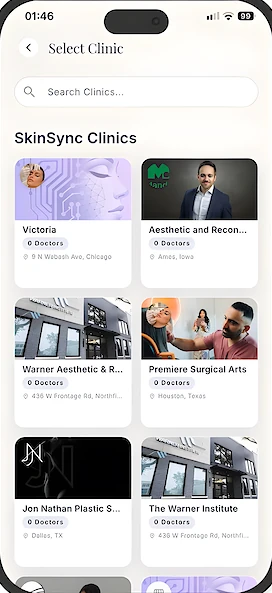
- Find participating clinics and providers, with availability and pricing
- Book a consultation, in person or virtual, or a treatment in the app
- Save your scans and get reminders and aftercare guidance


Simulations are illustrative and do not predict results. The app does not give medical advice; a licensed provider determines appropriate treatment.
Sources
Every medical fact on this page is linked to one of these sources. Reviewed October 30, 2026.
- U.S. Food and Drug Administration: Dermal Fillers (Soft Tissue Fillers)
- U.S. Food and Drug Administration: FDA-Approved Dermal Fillers
- U.S. Food and Drug Administration: Dermal Fillers (Soft Tissue Fillers); American Society of Plastic Surgeons: Dermal Fillers Procedure Steps
- U.S. Food and Drug Administration: Summary of Safety and Effectiveness Data, JUVEDERM VOLUMA XC (PMA P110033/S070)
- U.S. Food and Drug Administration: Summary of Safety and Effectiveness Data, Restylane Lyft with Lidocaine (PMA P040024/S099)
- American Academy of Dermatology: Fillers, FAQs
- American Society of Plastic Surgeons: How much do dermal fillers cost?
- American Society of Plastic Surgeons: Dermal fillers
- Kroumpouzos G, Treacy P. Hyaluronidase for dermal filler complications: review of applications and dosage recommendations. JMIR Dermatology, 2024 (PubMed Central)
- U.S. Food and Drug Administration: Dermal Filler Do's and Don'ts for Wrinkles, Lips and More
Related guides
Juvederm, Juvederm Voluma, Restylane, Restylane Lyft, Radiesse, Sculptra and Bellafill are trademarks of their respective owners. SkinSync AI is not affiliated with or endorsed by these companies.