
Dermal fillers: treatment guide
Dermal fillers: types, results, side effects and cost
What are dermal fillers?
Dermal fillers are gel-like substances that a licensed provider injects under the skin to create a smoother or fuller appearance. The FDA regulates them as medical devices and has approved specific products for specific uses in adults 22 and older, such as softening deep facial folds and adding volume to the lips, cheeks and chin. Most fillers are temporary because the body gradually absorbs them, so treatment is repeated to keep the effect.[1][3]

Dermal filler quick facts
| What it is | Gel-like substances injected under the skin, regulated by the FDA as medical devices[3] |
|---|---|
| What it treats | Moderate to severe facial wrinkles and folds; added fullness of the lips, cheeks, chin, under-eye hollows, jawline and back of the hand; facial fat loss in people with HIV; acne scars on the cheek[3] |
| Who it is approved for | Adults 22 and older, for the specific uses each product is approved for[1][3] |
| How long it lasts | Depends on the material and the area: about 6 to 12 months for hyaluronic acid, about 18 months for calcium hydroxylapatite, up to 2 years for poly-L-lactic acid; PMMA is not absorbed[1][2] |
| Results timeline | Most fillers show results immediately; poly-L-lactic acid builds over several weeks[2][5] |
| Treatment time | Most treatments take 15 to 30 minutes in one office visit[5] |
| Downtime | Most people return to everyday activities right after treatment[5][8] |
| Cost | Varies by clinic and area. Depends on the type of filler, the provider, the time the treatment takes and the location.[7] |
| Insurance | Treatment for signs of aging is not covered[4][7] |
How dermal fillers work
As we age, the face naturally loses fat under the skin and the skin stretches, so lines such as smile lines become more visible and the face loses fullness.[6] Fillers are injected under the skin to smooth lines and restore volume.[3][8]
The FDA groups filler materials into two kinds. Absorbable (temporary) fillers are broken down by the body over time. Only one FDA-approved filler is made from a material that stays in the body and is not absorbed. Some fillers also contain lidocaine, a numbing medicine, to make the injection more comfortable.[2]
Types of dermal fillers
Swipe sideways to see the whole table.
| What it is | How long it lasts | Examples | |
|---|---|---|---|
| Hyaluronic acid (HA) | A sugar found naturally in skin and cartilage. It binds water and swells as a gel, which smooths and fills.[2] | Temporary, about 6 to 12 months[2] | Juvederm, Restylane[7] |
| Calcium hydroxylapatite (CaHA) | A mineral found in teeth and bones, as tiny particles in a gel. It shows up on x-rays.[2] | Temporary, about 18 months[2] | Radiesse[7][8] |
| Poly-L-lactic acid (PLLA) | A biodegradable man-made polymer, given as a series of injections over several months. It helps the body make its own collagen.[2][8] | Builds over weeks; may last up to 2 years[2] | Sculptra[7][8] |
| Polymethylmethacrylate (PMMA) | Tiny smooth beads that the body does not absorb, in a gel containing cow (bovine) collagen.[2] | Not absorbed (permanent)[2][3] | Bellafill[7][8] |
Some providers use your own fat as a filler. It is removed from another part of your body with liposuction, processed and injected into the face. This is a more involved procedure.[5][8]
FDA-approved uses
Each filler product is reviewed and approved by the FDA for use in specific areas of the face or hands, so ask your provider which product they plan to use and whether it is approved for the area you want treated.[1]
- Correcting moderate to severe facial wrinkles and skin folds, such as the nasolabial folds[1][3]
- Adding fullness to the lips, cheeks, chin, under-eye hollows, jawline and back of the hand[3]
- Restoring facial fat loss in people with HIV[1][3]
- Correcting acne scars on the cheek[3]
The FDA has not approved injectable silicone or any filler for body contouring, such as enlarging the breasts or buttocks, and has not approved needle-free injection devices for fillers.[1][3]
Filler guides by area
Each area guide covers what to expect, risks and aftercare for that part of the face.
- Lip filler
- Cheek filler
- Tear trough (under-eye) filler
- Temple filler
- Chin filler
- Jawline filler
- Nasolabial fold filler: the lines from the sides of the nose to the edges of the mouth[1]
What to expect, step by step
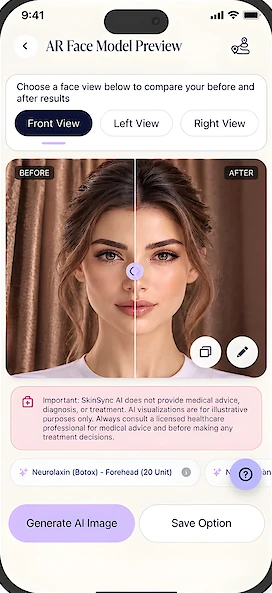
- Before your consultation: preview it in the appIf you like, scan your face in the SkinSync AI app and look at an illustrative filler simulation, so you can show your provider what you have in mind. A simulation does not predict your result, and your provider decides what is appropriate for you.
- ConsultationYour provider examines your face, asks about your goals and reviews your medical history and medicines. Tell them about allergies, any history of bruising or bleeding, other medical conditions and skin conditions.[8] The FDA suggests asking about your provider's training and experience with fillers and reading the patient labeling for the product you will receive.[1]
- Allergy testing, if neededA few fillers require an allergy test first, and you wait for the result before treatment.[5]
- PreparationDepending on the filler and the area, you may have ice, a numbing cream or a nerve block (an injection). Lips often need a nerve block.[5]
- InjectionsThe filler is injected with a syringe and a fine needle or a cannula (a thin tube with a blunt tip), often in several spots. You may feel stinging or burning. Most treatments take 15 to 30 minutes.[3][5]
- Right afterYour provider may recommend icing for 15 to 20 minutes before you leave. You can usually apply makeup and return to everyday activities.[5]
- ResultsMost fillers produce results right away. Poly-L-lactic acid works gradually, over several weeks.[2][5]
- MaintenanceTemporary fillers are absorbed over time. You can usually be treated again when signs of aging reappear.[3][5]
Side effects and who should avoid dermal fillers
Common side effects
Most side effects happen shortly after the injection, and many resolve in a few days to weeks.[1] They can include:
These minor side effects tend to clear within 7 to 14 days.[5] Less common risks include nodules or lumps under the skin (which may need injections, antibiotics or surgical removal), infection, a sore at the injection site and allergic reaction. Some side effects can appear weeks, months or years after injection.[1][3]
Serious but rare: filler injected into a blood vessel
The FDA calls unintended injection into a blood vessel the most serious risk of dermal fillers. Filler that blocks a blood vessel can cut off blood supply and cause tissue death (necrosis), vision problems including blindness, or stroke. The chances are low, but these complications can be serious and permanent.[1][3]
Get medical help right away if you have unusual pain, vision changes, skin near the injection site that turns white, gray or blue, or any signs of a stroke (sudden trouble speaking, numbness or weakness, trouble walking, face drooping, severe headache, dizziness or confusion) during or shortly after treatment.[1]
Who should avoid fillers or talk to a provider first
- Under 22. Safety is unknown in people under 22.[1]
- Pregnancy or breastfeeding. Safety is unknown.[1]
- A tendency to form keloids or raised scars. Safety is unknown.[1]
- Inflamed or infected skin, such as cysts, pimples, rashes or hives. Treatment should wait until it is managed.[1]
- A bleeding disorder[1]
- Severe allergies or a history of anaphylaxis, or allergies to lidocaine, collagen, eggs, animal products or bacteria-derived ingredients, which some fillers contain[1]
Only get fillers from a licensed provider
The FDA advises choosing a licensed provider experienced in dermatology or plastic surgery and trained to inject fillers. Do not buy fillers sold directly to the public, do not inject yourself, and do not use needle-free filler "pens".[1][3] Avoid injections at a non-medical spa, a party, a salon or someone's home.[5]
Dermal filler aftercare
- Wait until the next day to exercise or do other strenuous activity.[5]
- Stay out of the sun and avoid tanning beds after treatment.[5]
- Do not touch the treated area for three days, unless your provider tells you to massage it.[5]
- Poly-L-lactic acid is different: you may be asked to gently massage the area for about 5 minutes several times a day for 1 to 2 weeks.[5]
- Call your provider about bleeding or pain, signs of infection such as fever, redness and swelling, or signs of an allergic reaction.[8]
- Get emergency care for vision changes, skin turning white, gray or blue, or signs of a stroke.[1]
Dermal fillers vs Botox
Fillers and Botox are both injections, but they are different products that work in different ways. Botox and other botulinum toxins are drugs that keep muscles from tightening, so lines caused by movement show less. Fillers are medical devices that add volume under the skin.[3] See our Botox guide for more.
Swipe sideways to see both treatments.
| Dermal fillers | Botox | |
|---|---|---|
| What it is | A gel-like medical device[3] | An injectable prescription drug (botulinum toxin)[3] |
| How it works | Fills and adds volume under the skin[3] | Relaxes the muscles that cause certain lines[3] |
| Common cosmetic uses | Wrinkles and folds; fullness of lips, cheeks, chin, under-eye hollows and jawline[3] | Frown lines, forehead lines and crow's feet[3] |
| When results show | Immediately for most fillers[5] | Within 3 to 7 days for most people[10] |
| How long it lasts | Depends on the material, from months to years[2] | About 3 to 4 months, sometimes longer[10] |
| Used together? | The FDA notes that the safety of using fillers together with Botox has not been evaluated in controlled clinical studies.[1][3] | |
Which treatment suits you, or whether to combine them, is a decision to make with a licensed provider.
Frequently asked questions about dermal fillers
How long do dermal fillers last?
It depends on the filler and where it is injected. The FDA gives about 6 to 12 months for hyaluronic acid, about 18 months for calcium hydroxylapatite and up to 2 years for poly-L-lactic acid. Other guidance gives ranges of 4 to 12 months for hyaluronic acid, 6 months to 1 year for calcium hydroxylapatite and 1 to 3 years for poly-L-lactic acid. Ask your provider how long the filler they recommend should last in your area.[1][2][5]
Are dermal fillers FDA approved?
Yes, specific fillers are approved by the FDA as medical devices for specific uses in adults 22 and older. The FDA has approved different products for different areas of the face and hands, so ask which product you will receive and read its patient labeling.[1][3]
What is the difference between fillers and Botox?
Botox is a drug that relaxes the muscles behind certain lines. Fillers are gel-like devices that add volume under the skin. They are not the same product, and the FDA notes that their safe use together has not been evaluated in clinical studies.[3]
Can dermal fillers be dissolved or removed?
Removing or reducing filler may require injections, surgery or other procedures, which carry their own risks, and some fillers can be difficult or impossible to remove, especially permanent fillers or fillers not made of hyaluronic acid.[1] Hyaluronic acid fillers can be broken down with an enzyme called hyaluronidase.[9]
Do filler injections hurt?
You may feel stinging or burning during the injections. Depending on the area, your provider may use ice, a numbing cream or a nerve block, and some fillers contain lidocaine to reduce discomfort.[2][5]
Is there downtime after fillers?
Most fillers do not cause downtime, and most people go back to everyday activities right after treatment. Ask your provider, because it varies with the filler.[5]
When will I see results?
Most fillers fill the skin right away, so results are immediate or close to it. Poly-L-lactic acid works gradually and becomes more visible over several weeks.[2][5]
What is the most serious risk of fillers?
Accidental injection into a blood vessel. It is rare, but it can cause tissue death, blindness or stroke. Get help right away for unusual pain, vision changes, skin color changes near the injection or signs of a stroke.[1][3]
Will fillers look natural?
Natural-looking results depend on the injector's expertise, and a conservative approach is recommended rather than overdoing it.[5]
Can I buy filler online or use a filler pen at home?
No. The FDA warns against buying fillers sold directly to the public, which may be fake or contaminated, against injecting yourself and against needle-free injection pens. FDA-approved fillers are prescription devices injected by a licensed provider.[1][3]
SkinSync AI: Aesthetic Care
See a simulation before you book.
Read up here, then use the app to picture filler on your own face and take the next step with a clinic. Arrive at your consultation informed and ready to ask the right questions.
- Scan your face and see an illustrative dermal filler simulation from the front and both sides: lips, cheeks, tear troughs, temples, chin, jawline, nasolabial folds and more
- Find participating clinics and providers, with availability and pricing
- Book a consultation, in person or virtual, or a treatment in the app
- Save your scans and get reminders and aftercare guidance


Simulations are illustrative and do not predict results. The app does not give medical advice; a licensed provider determines appropriate treatment.

Sources
Every medical fact on this page is linked to one of these sources. Reviewed October 30, 2026.
- U.S. Food and Drug Administration: Dermal Fillers (Soft Tissue Fillers)
- U.S. Food and Drug Administration: FDA-Approved Dermal Fillers
- U.S. Food and Drug Administration: Dermal Filler Do's and Don'ts for Wrinkles, Lips and More
- American Academy of Dermatology: Fillers, overview
- American Academy of Dermatology: Fillers, FAQs
- American Society of Plastic Surgeons: Dermal fillers
- American Society of Plastic Surgeons: How much do dermal fillers cost?
- Clinical, Cosmetic and Investigational Dermatology: Patient factors influencing dermal filler complications: prevention, assessment, and treatment (2015); Journal of Cutaneous and Aesthetic Surgery: Fat Ful'fill'ment: A Review of Autologous Fat Grafting (2013)
- Kroumpouzos G, Treacy P. Hyaluronidase for dermal filler complications: review of applications and dosage recommendations. JMIR Dermatology, 2024 (PubMed Central)
- American Academy of Dermatology: Botulinum toxin therapy, overview
Related guides
Juvederm, Restylane, Radiesse, Sculptra, Bellafill and Botox are trademarks of their respective owners. SkinSync AI is not affiliated with or endorsed by these companies.