
Laser and energy-based: treatment guide
Pico laser: what it is, results, side effects and cost
What is a pico laser?
A pico laser is a picosecond laser: it delivers pulses shorter than one nanosecond, which destroy pigment with less damage to the surrounding skin than older nanosecond (Q-switched) lasers.[2] First used to remove tattoos, picosecond lasers are now used for sun spots and other benign pigmented spots, sun damage, melasma and scars.[1]

Pico laser quick facts
| What it is | A laser with pulses shorter than one nanosecond (the picosecond range), used to remove pigment and tattoos[2] |
|---|---|
| What it is used for | Benign pigmented spots such as sun spots, sun damage, melasma, scars and tattoos[1] |
| Wavelengths | Several, including 532, 755 and 1064 nm; results differ by wavelength and settings[5][10] |
| Typical sessions for age spots | Often one or two laser treatments[6][9] |
| Downtime | Depends on the intensity used: lower settings mean minimal downtime with more sessions, higher settings mean more downtime with fewer sessions[7] |
| Common side effects | Crusting and temporary darkening of the treated spots, which tend to fade quickly[6] |
| Darker skin tones | Darker skin is more prone to burns and dark marks after laser treatment, so choose a provider experienced with your skin tone[7] |
| Cost | Varies by clinic and area. Ask the clinic for the price of the full plan. |
How pico lasers work
Lasers that remove pigment send very short pulses of light that are absorbed by the pigment. Older pigment lasers, called Q-switched lasers, use pulses in the nanosecond range. Picosecond lasers use pulses shorter than one nanosecond, which destroy pigment more effectively with less damage to the surrounding normal skin.[2]
Picosecond lasers were first used mainly to remove tattoos. Their uses have since grown to include benign pigmented spots, sun damage, melasma and scar revision. A 2021 review of 77 studies concluded that picosecond lasers are a safe and effective treatment for a growing range of skin conditions.[1]
Pico lasers come in different wavelengths, and studies have compared them. In a study of 30 people with sun spots on the arms, both a 532 nm and a 755 nm picosecond laser improved the spots, and the authors concluded that the right settings matter most.[10]
Not every dark spot is a sun spot. What looks like an age spot can be skin cancer, so get a skin exam by a board-certified dermatologist before treating age spots.[6]
What to expect, step by step
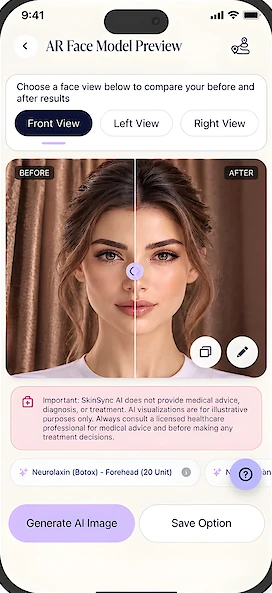
- Before your consultation: use the appPico Laser simulation is coming soon to the SkinSync AI app. Today you can already scan your face, see neurotoxin and filler simulations, find a clinic and book.
- Skin exam and consultationA dermatologist checks that your spots are harmless before treating them.[6] Tell your provider every skin care product, medicine and supplement you use, because some make the skin more sensitive to laser light.[7]
- PreparationAvoid tanning and protect your skin from the sun. You may need to stop products such as topical retinoids, stop smoking, or start an antiviral or antibiotic medicine if your dermatologist prescribes one.[7]
- TreatmentThe laser is applied to the spots. The intensity your provider chooses affects both the number of sessions and the downtime.[7]
- Right afterTreated spots can crust or turn temporarily darker. These side effects tend to fade quickly.[6]
- ResultsIn a study of 15 people with sun spots in skin types III and IV, a single session of a 670 nm picosecond laser cleared the spots at the 3-month follow-up.[4] Results vary, and many people need only one or two laser sessions for dark spots.[9]
- Keep spots from returningAge spots can come back. Daily sun protection helps prevent this.[6]
Side effects and who should avoid a pico laser
Possible side effects
- Crusting of the treated spots[6]
- Temporary darkening of the treated spots[6]
- Temporary lighter or darker patches of skin (hypopigmentation or hyperpigmentation). In one study they occurred in 9% and 14% of people and cleared within 3 months[4]
- Burns and dark marks, which are more likely in darker skin[7]
Picosecond lasers may cause less post-inflammatory hyperpigmentation (dark marks after treatment) than Q-switched lasers. In a split-face study of 20 people with sun spots, dark marks developed on 5% of the picosecond-treated sides and 30% of the Q-switched sides.[3]
Have your spots checked first
What looks like an age spot could be skin cancer. See a board-certified dermatologist for a skin exam before you treat age spots.[6]
Who should talk to a provider first
- Darker skin tones. Work with a board-certified dermatologist who has experience treating darker skin with lasers.[7]
- A recent tan. Avoid tanning once a laser treatment has been chosen.[7]
- Medicines or skin care that increase light sensitivity, including topical retinoids[7]
- Melasma. Laser results for melasma are mixed, and lasers work best added to medicine and sun protection[2][5][8]
Choose a qualified provider
The results of a laser procedure depend largely on the skill of the person performing it. Limited training, supervision and equipment in non-medical settings such as spas and shopping malls may put your health and safety at risk.[7]
Pico laser aftercare
Follow your own provider's instructions first. Advice after treating age spots centers on the sun:[6]
- Seek shade and wear sun-protective clothing, such as a long-sleeve shirt, a wide-brimmed hat and UV-protective sunglasses.[6]
- Use sunscreen every day on all skin not covered by clothing: broad-spectrum, SPF 30 or higher and water resistant.[6][7]
- Let crusting fade on its own. Crusting and temporary darkening tend to fade quickly.[6]
- Keep up sun protection long term, because age spots can return.[6]
Pico vs other lasers
The closest comparison is the Q-switched laser, the older nanosecond laser used for the same pigment problems. Picosecond lasers have been reported to remove tattoos in fewer sessions with fewer unwanted side effects, and to cause fewer dark marks after treatment in Asian skin, which is prone to them.[2]
Swipe sideways to see both lasers.
| Picosecond (pico) laser | Q-switched laser | |
|---|---|---|
| Pulse length | Shorter than one nanosecond[2] | Nanoseconds[2] |
| Sun spots, 20-person split-face study | More effective[3] | Effective, but less so[3] |
| Dark marks after treatment in that study | 5% of treated sides[3] | 30% of treated sides[3] |
| Tattoos | Removed in fewer sessions[2] | More sessions[2] |
| Melasma | 1064 nm reduced melasma scores; 755 nm was not better than topical lightening creams and caused dark marks[5] | Not compared on this page |
Pico lasers target pigment. For redness and overall skin tone, see our Laser Genesis guide. For texture, lines and scars, resurfacing lasers such as Fraxel, the CO2 laser and the erbium laser work differently: they heat or remove layers of skin.
Which treatment suits you is a decision to make with a licensed provider.
Frequently asked questions about pico lasers
What does a pico laser treat?
Picosecond lasers were first developed for tattoo removal. They are now also used for benign pigmented spots such as sun spots, sun damage, melasma and scars.[1]
Is a pico laser better than a Q-switched laser?
For pigment, picosecond lasers can destroy pigment more effectively with less damage to nearby skin.[2] In one split-face study of sun spots, the picosecond side cleared better and had fewer dark marks afterward (5% vs 30%).[3] Both lasers worked, and your provider will choose based on your skin.
How many sessions do sun spots need?
Many people need only one or two laser treatments for age spots.[6][9] In one small study, a single picosecond session cleared sun spots by the 3-month follow-up.[4]
Does a pico laser work for melasma?
Results are mixed. A 2023 review of six trials found that 1064 nm picosecond lasers reduced melasma scores, while 755 nm picosecond lasers were not better than topical lightening creams and caused dark marks.[5] Adding a laser or light treatment can improve results for people already using medicine on their skin and protecting it from the sun.[8]
Is a pico laser safe for darker skin?
Lasers can be used on all skin types, but darker skin is more prone to burns and dark marks after laser treatment. Choose a board-certified dermatologist experienced in treating darker skin with lasers.[7] Picosecond lasers are reported to cause less post-inflammatory hyperpigmentation in Asian skin than Q-switched lasers.[2]
Is there downtime?
It depends on the settings. Pigment lasers can be used at lower intensity with minimal downtime and more sessions, or at higher intensity with more downtime and fewer sessions.[7]
What side effects are common?
Crusting and temporary darkening of treated spots are common and tend to fade quickly.[6] Temporary lighter or darker patches can also occur.[4]
Will my sun spots come back?
They can. Protecting your skin from the sun with shade, clothing and broad-spectrum SPF 30 or higher sunscreen helps prevent age spots from returning.[6]
Should I have my spots checked before laser treatment?
Yes. What looks like an age spot could be skin cancer, so get a skin exam by a board-certified dermatologist first.[6]
Can I see a pico laser simulation in the SkinSync AI app?
Not yet. Pico Laser simulation, for pigmentation correction including sunspots and discoloration, is coming soon. Today you can already scan your face, see neurotoxin and filler simulations, find a clinic and book. Simulations are illustrative and do not predict results.
SkinSync AI: Aesthetic Care
Coming soon
See a simulation before you book.
Pico laser simulation is coming soon to the SkinSync AI app. Today you can already scan your face, see neurotoxin and filler simulations, find a clinic and book.
- Coming soon: an illustrative Pico laser simulation for pigmentation correction, including sunspots and discoloration
- Available now: scan your face and see illustrative neurotoxin and filler simulations from the front and both sides
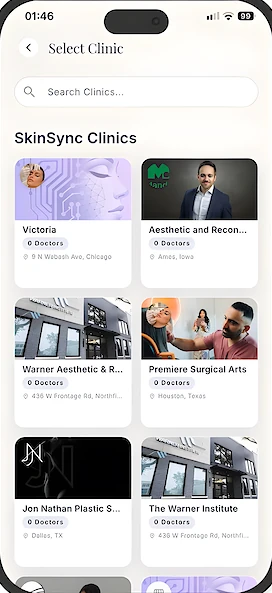
- Find participating clinics and providers, with availability and pricing
- Book a consultation, in person or virtual, or a treatment directly in the app
- Save your scans and get reminders and aftercare guidance


Simulations are illustrative and do not predict results. The app does not give medical advice; a licensed provider determines appropriate treatment.
Sources
Every medical fact on this page is linked to one of these sources. Reviewed October 30, 2026.
- Wu DC, Goldman MP, Wat H, Chan HHL. A systematic review of picosecond laser in dermatology: evidence and recommendations. Lasers in Surgery and Medicine, 2021 (PubMed)
- Kasai K. Picosecond laser treatment for tattoos and benign cutaneous pigmented lesions. Laser Therapy, 2017 (PubMed)
- A split-face, single-blinded, randomized controlled comparison of 532 nm picosecond Nd:YAG laser versus 532 nm Q-switched Nd:YAG laser in the treatment of solar lentigines. Annals of Dermatology, 2020 (PubMed)
- Evangelista KER, Manuskiatti W, et al. Clinical evaluation of safety and efficacy of a 670-nm picosecond laser for treatment of benign pigmented lesions in Asians. Dermatologic Surgery, 2021 (PubMed)
- Feng J, et al. Efficacy and safety of picosecond laser for the treatment of melasma: a systematic review and meta-analysis. Lasers in Medical Science, 2023 (PubMed)
- American Academy of Dermatology: What can get rid of age spots?
- American Academy of Dermatology: Skin conditions that lasers can treat
- American Academy of Dermatology: Melasma: Diagnosis and treatment
- Journal of Cosmetic Dermatology: Treatment of Solar Lentigines: A Systematic Review of Clinical Trials (2025)
- Randomized, evaluator-blinded comparative study of a KTP 532-nm picosecond laser and an alexandrite 755-nm picosecond laser for the treatment of solar lentigines in Asians. Journal of Cosmetic Dermatology, 2022 (PubMed)
Related guides
Fraxel, Laser Genesis and Morpheus8 are trademarks of their respective owners. SkinSync AI is not affiliated with or endorsed by these companies.