
Laser and energy-based: treatment guide
Erbium laser resurfacing: what it is, results, side effects and cost
What is erbium laser resurfacing?
Erbium laser resurfacing uses an erbium (Er:YAG) laser to remove superficial and moderately deep lines and wrinkles on the face, and it can also be used on the hands, neck or chest.[1][3] It is an ablative treatment that causes minimal injury to surrounding tissue and fewer side effects than CO2 lasers, so recovery is usually quicker.[1]

Erbium laser quick facts
| What it is | An ablative laser, the erbium-doped yttrium aluminum garnet (Er:YAG) laser, that removes the outer layer of skin and part of the layer beneath it[3] |
|---|---|
| What it treats | Superficial and moderately deep lines and wrinkles on the face; also used on the hands, neck and chest[1][2] |
| Forms | Can be used in a traditional or a fractional setting, depending on the goal[3] |
| Anesthesia | Should require only a local anesthetic[1] |
| Recovery | About one full week[1] |
| Side effects | Fewer than with CO2 lasers, such as swelling, bruising and redness[1][2] |
| Results | Skin can keep improving for up to a year, and the effects can last for years[9] |
| Cost | Varies by clinic and area. Depends on the provider's expertise, the type of procedure, the time it takes and the location.[11] |
| Insurance | Not covered when done as elective cosmetic treatment[1] |
How erbium laser resurfacing works
Laser resurfacing sends short, concentrated pulses of light at irregular skin and removes damaged skin one layer at a time.[7] Removing the outer layer and heating the layer underneath stimulates new collagen, and the new skin that forms as the area heals is smoother and firmer.[1][7]
Ablative lasers work because light energy is absorbed by water and melanin in the skin, which turns into heat and removes the targeted tissue.[3] The Er:YAG laser was developed after pulsed CO2 lasers and became popular in the late 1990s; it improved the precision and depth control of resurfacing and reduced side effects.[3][4]
One benefit of erbium resurfacing is minimal injury to the surrounding tissue.[1] In a split-face study, biopsies showed heat damage reaching up to 50 micrometers below the surface on the erbium-treated side and up to 200 micrometers on the CO2-treated side, and the erbium side recovered more quickly.[5]
Erbium lasers can also be used in a fractional setting, which treats microscopic columns of skin and leaves the skin around them untouched.[1][3][15] Erbium resurfacing is not the same thing as Fraxel: the Fraxel laser described in research is a nonablative 1,550 nm erbium fiber laser, a different device.[17][18] For deeper resurfacing, see our CO2 laser guide.
What to expect, step by step
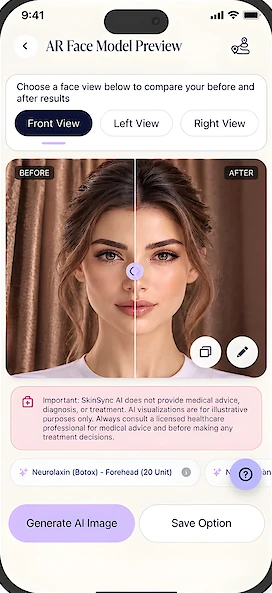
- Before your consultation: see what the app offers todayErbium laser simulation is coming soon to the SkinSync AI app. Today you can already scan your face, see neurotoxin and filler simulations, find a clinic and book a consultation. A simulation does not predict an outcome, and your provider decides what is appropriate for you.
- ConsultationYour doctor chooses the type of laser resurfacing after reviewing your medical history, current health and goals.[1] Tell the provider if you get cold sores, have a medical condition such as diabetes, smoke, or take any medicines or supplements.[12]
- PreparationAvoid tanning and strong sun and use a broad-spectrum sunscreen daily for four weeks before treatment. If you have had cold sores or shingles in the area, you may start antiviral medicine as directed. Dermatologists also advise stopping retinoid or glycolic acid skin care for 2 to 4 weeks and quitting smoking for at least 2 weeks.[1][12]
- Treatment dayErbium resurfacing usually needs only a topical or local anesthetic.[1]
- Right afterTreated areas are usually dressed after the procedure, and you soak, apply ointment and re-dress the area each day.[2]
- HealingHealing after laser resurfacing takes about three to 10 days, depending on the depth of treatment and the type of laser.[2] Erbium-treated skin typically resurfaces in about five days.[1]
- ResultsYou may see a difference right away, and skin can keep improving for up to a year. Lines return with normal aging, and treatment can be repeated.[9]
Side effects and who should avoid erbium laser resurfacing
Common side effects
Erbium lasers cause fewer side effects than CO2 lasers, such as swelling, bruising and redness.[1] After laser resurfacing, skin most often feels like a mild sunburn, with some redness and swelling, and itching or stinging for a few days.[8]
- Darkening of the skin (hyperpigmentation), or more rarely lightening (hypopigmentation)[1][8]
- Cold sore reactivation, mainly when skin around the mouth is treated[8]
- Bacterial infection[8]
- Milia, small white bumps that can appear during healing[1][8]
- Redness that takes longer than usual to fade[8]
- Scarring[1]
In the split-face study comparing the two lasers, redness at 2 weeks was seen on 14 of 21 erbium-treated sides and 20 of 21 CO2-treated sides, and skin lightening on 1 erbium-treated side versus 9 CO2-treated sides.[5] Darker skin is more prone to burns and dark marks after any laser treatment,[13] though erbium causes pigment changes less often than CO2.[1]
A tan means no treatment that day
If you arrive with a tan or sunburn, a dermatologist cannot treat you, because the laser could cause a serious burn or discolor your skin.[12]
Who should avoid erbium laser resurfacing or talk to a provider first
- Active acne[1][2]
- A tan or sunburn in the treatment area[12]
- A history of cold sores, which calls for antiviral medicine before and after treatment[2][8]
- Deep wrinkles or excess sagging skin, which laser resurfacing is not ideal for
- Diabetes or another medical condition, or smoking, which you should discuss first[12]
- Medicines or supplements that can make skin more sensitive to laser light; tell your provider everything you take[13]
Erbium laser aftercare
Follow your provider's instructions; at-home care helps healing and helps prevent side effects.[12] General laser resurfacing guidance includes:
- Clean the treated areas two to five times a day with saline or a diluted vinegar solution, as directed.[8]
- Do not scratch or pick at crusts, which can cause scarring.[8]
- Use an ice pack during the first day or two to ease swelling and discomfort.[8]
- Do not smoke, because tobacco smoke complicates healing.[8]
- Wait on retinoid and glycolic acid products until about six weeks after treatment, or as your provider directs.[8]
- Use sunscreen every day after healing, a broad-spectrum facial sunscreen with SPF 30 or higher. Skin can be extra sensitive to sunlight for up to a year.[9]
Erbium vs CO2 vs Fraxel
All three are laser resurfacing treatments, but they work in different ways. CO2 and erbium lasers are ablative: they remove the outer layers of skin.[3] Fractional delivery, which treats microscopic columns of skin and leaves the skin around them untouched, can be used with ablative or nonablative lasers.[1][4][15]
Swipe sideways to see all three lasers.
| Erbium laser | CO2 laser | Fraxel | |
|---|---|---|---|
| Laser type | Ablative (Er:YAG). Can be delivered in a traditional or a fractional form[3] | Ablative. Can be delivered in a traditional or a fractional form[1][3] | Fractional laser. The Fraxel laser studied in the cited research is a nonablative fractional laser[17][18] |
| Effect on the skin surface | Removes the outer layer and part of the layer beneath it[3] | Removes the outer layer and part of the layer beneath it[3][16] | Heats narrow columns of skin while the outer layer stays in place[4][17] |
| Commonly used for | Superficial and moderately deep lines and wrinkles on the face, hands, neck or chest[1][2] | Wrinkles, sun damage, scars, warts, birthmarks and enlarged oil glands on the nose[16] | Sun damage on and off the face, atrophic acne scars, light-colored scars and uneven pigment[17] |
| Recovery, per the cited source | One full week[1] | Up to two weeks[1]; treated areas heal in 10 to 21 days[16] | No downtime with a nonablative laser[12] |
| Side effects compared | Fewer side effects than CO2, such as swelling, bruising and redness[1] | In a split-face study, more redness at 2 weeks and more lightening of the skin than the erbium side[5] | Faster recovery than ablative resurfacing[4] |
| Darker skin tones | May be a good choice for a darker skin tone[1] | Greater risk of healing with darker pigmentation[16] | A review found fractional lasers a favorable option for skin types IV to VI, with few high-quality studies in types V and VI[19] |
| Strength of results | With more than 5 passes, wrinkle improvement was not significantly different from 2 to 3 passes of CO2 in that study[5] | Better overall wrinkle improvement than erbium in one split-face study[5] | Nonablative and fractional resurfacing do not produce results comparable to ablative resurfacing[4] |
Settings matter as much as the laser. In a smaller side-by-side study, when erbium and CO2 lasers were set to cause an equivalent injury, healing and wrinkle improvement were equivalent.[6]
Which laser suits you is a decision to make with a licensed provider.
Frequently asked questions about Erbium laser
How long is recovery after erbium laser resurfacing?
Expect about one full week of recovery for erbium resurfacing, compared with up to two weeks for CO2.[1] Healing after laser resurfacing generally takes three to 10 days, depending on depth and the type of laser.[2]
What does an erbium laser treat?
Erbium resurfacing is designed to remove superficial and moderately deep lines and wrinkles on the face, and it can be used on the hands, neck or chest.[1][2]
Does erbium laser resurfacing hurt?
Erbium resurfacing should require only a local anesthetic.[1] For larger areas, providers may use a nerve block or sedation.[2]
Is erbium gentler than CO2?
Erbium lasers cause fewer side effects than CO2 lasers, such as swelling, bruising and redness, so recovery should be quicker.[1] In one split-face study, CO2 gave better overall wrinkle improvement, but the erbium side recovered faster.[5]
Is erbium the same as Fraxel?
No. The erbium laser used for resurfacing is the ablative Er:YAG laser.[3] The Fraxel laser in published research is a nonablative fractional 1,550 nm erbium fiber laser.[17][18] See our Fraxel guide.
Is erbium laser good for darker skin?
Erbium resurfacing may be a good choice for people with a darker skin tone.[1] Darker skin is still more prone to burns and dark marks after laser treatment, so choose a dermatologist experienced with darker skin.[13]
How long do erbium laser results last?
Skin can keep improving for up to a year and the effects can last for years, but normal aging brings new lines, which can be treated again.[9]
Can erbium laser treat acne scars?
Dermatologists use lasers to resurface skin with acne scars; the skin makes collagen and elastin as it heals, which can make scars less noticeable.[14] Laser treatment cannot get rid of a scar completely.[12]
How much does erbium laser resurfacing cost?
Varies by clinic and area. Your price depends on the provider's expertise, the type of procedure, the time and effort it takes and the location.[11]
Does insurance cover erbium laser resurfacing?
Insurance does not cover laser resurfacing done as elective cosmetic treatment.[1]
Can I simulate an erbium laser treatment in the SkinSync AI app?
Not yet. Erbium laser simulation is coming soon to the SkinSync AI app. Today you can already scan your face, see neurotoxin and filler simulations, find a clinic and book. Simulations are illustrative and do not predict outcomes.
SkinSync AI: Aesthetic Care
Coming soon
Erbium laser simulation is coming soon.
Erbium laser simulation is coming soon to the SkinSync AI app. Today you can already scan your face, see neurotoxin and filler simulations, find a clinic and book. When it arrives, the Erbium laser simulation will cover fine lines, uneven texture and skin rejuvenation.
- Scan your face and see an illustrative neurotoxin or filler simulation from the front and both sides
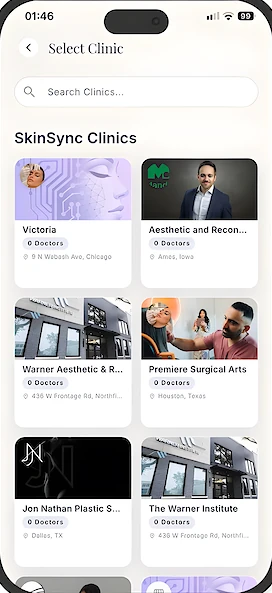
- Find participating clinics and providers, with availability and pricing
- Book a consultation, in person or virtual, or a treatment in the app
- Save your scans and get reminders and aftercare guidance


Simulations are illustrative and do not predict results. The app does not give medical advice; a licensed provider determines appropriate treatment.
Sources
Every medical fact on this page is linked to one of these sources. Reviewed October 30, 2026.
- StatPearls (NCBI Bookshelf): Laser Erbium-Yag Resurfacing (2023); StatPearls (NCBI Bookshelf): Ablative Laser Resurfacing (2023)
- American Society for Dermatologic Surgery: Laser resurfacing
- Verma N, Yumeen S, Raggio BS. Ablative laser resurfacing. StatPearls, National Library of Medicine (PubMed)
- Alexiades-Armenakas MR, Dover JS, Arndt KA. The spectrum of laser skin resurfacing: nonablative, fractional, and ablative laser resurfacing. J Am Acad Dermatol. 2008;58(5):719-737 (PubMed)
- Khatri KA, Ross V, Grevelink JM, Magro CM, Anderson RR. Comparison of erbium:YAG and carbon dioxide lasers in resurfacing of facial rhytides. Arch Dermatol. 1999;135(4):391-397 (PubMed)
- Ross EV, et al. One-pass CO2 versus multiple-pass Er:YAG laser resurfacing in the treatment of rhytides. Dermatol Surg. 2001;27(8):709-715 (PubMed)
- American Society of Plastic Surgeons: Laser skin resurfacing
- American Society of Plastic Surgeons: Laser skin resurfacing recovery
- American Society of Plastic Surgeons: Laser skin resurfacing results
- American Society of Plastic Surgeons: Laser skin resurfacing candidates
- American Society of Plastic Surgeons: Laser skin resurfacing cost
- American Academy of Dermatology: 10 things to know before having laser treatment for your scar
- American Academy of Dermatology: Skin conditions that lasers can treat
- American Academy of Dermatology: Acne scars, diagnosis and treatment
- Seminars in Plastic Surgery: Current Laser Resurfacing Technologies: A Review that Delves Beneath the Surface (2012)
- StatPearls (NCBI Bookshelf): Laser Carbon Dioxide Resurfacing (2023)
- Tanzi EL, Wanitphakdeedecha R, Alster TS. Fraxel laser indications and long-term follow-up. Aesthet Surg J. 2008;28(6):675-678 (PubMed)
- Friedman PM, Dover JS, et al. 1,550 nm erbium-doped and 1,927 nm thulium nonablative fractional laser system: best practices and treatment setting recommendations. Dermatol Surg. 2022;48(2):195-200 (PubMed)
- Kaushik SB, Alexis AF. Nonablative fractional laser resurfacing in skin of color: evidence-based review. J Clin Aesthet Dermatol. 2017;10(6):51-67 (PubMed)
Related guides
Fraxel and Botox are trademarks of their respective owners. SkinSync AI is not affiliated with or endorsed by these companies.