
Skin treatments: treatment guide
Sculptra and biostimulators: what they are, how they work, side effects and cost
What is Sculptra?
Sculptra is an FDA-approved injectable dermal filler made of poly-L-lactic acid (PLLA), a biodegradable, man-made material.[1][3] It is called a bio-stimulatory filler because it stimulates your own skin to produce new collagen, so its effect appears gradually over a few months rather than right away.[5] It is given as a series of injections, and its effects may last up to 2 years.[3]

Sculptra quick facts
| What it is | An injectable dermal filler made of poly-L-lactic acid (PLLA)[1][3] |
|---|---|
| Type | A bio-stimulatory filler that stimulates your skin to make new collagen[5] |
| FDA-approved uses | Nasolabial fold contour deficiencies and other facial wrinkles; fine lines and wrinkles in the cheek region; facial fat loss (lipoatrophy) in people with HIV[2] |
| Who gives it | A doctor injects it under the skin[1] |
| Sessions | Multiple sessions, often spaced about one month apart[5]; up to four injections were used in the FDA-reviewed cheek study[1] |
| Results timeline | Appears gradually over a few months[5] |
| How long it lasts | Up to 2 years[3]; the cheek study reported results lasting up to 24 months[1] |
| Common side effects | Bruising, redness, swelling, pain, tenderness, itching and rash, as with dermal fillers generally[4] |
| Other biostimulators | Calcium hydroxylapatite (Radiesse) also fills and can increase collagen over time[6] |
| Cost | Varies by clinic and area. Depends on the provider, the product, the time involved and location[10] |
How Sculptra works
PLLA is a biodegradable, biocompatible man-made polymer that is also used in absorbable stitches and bone screws.[3] Sculptra contains PLLA together with carboxymethylcellulose and mannitol, and is mixed with sterile water before use; lidocaine, a numbing medicine, can be added to reduce pain on injection.[1]
Instead of filling a wrinkle all at once, PLLA works as a bio-stimulatory filler: it stimulates your own skin to produce new collagen, and over time the skin breaks the PLLA down into water and carbon dioxide.[5] The FDA notes that PLLA is given in a series of injections over several months and that its effects become increasingly apparent over several weeks.[3]
What Sculptra is approved for
Sculptra was first approved by the FDA in 2004 to restore or correct the signs of facial fat loss (lipoatrophy) in people with HIV.[2] In 2009 it was approved for shallow to deep nasolabial fold contour deficiencies and other facial wrinkles, and in 2023 the FDA expanded its use to fine lines and wrinkles in the cheek region.[1][2] These later approvals are for people whose immune systems work normally (immune-competent).[1][2] The FDA approves dermal fillers in general for adults 22 and older.[4]
Calcium hydroxylapatite: another biostimulator
Calcium hydroxylapatite (CaHA), sold as Radiesse, is a mineral commonly found in teeth and bones, suspended in a gel for injection.[3] CaHA gives an immediate result and over time can also increase collagen production in the treated area.[6] Radiesse is FDA approved for moderate to severe facial wrinkles and folds such as nasolabial folds, for facial fat loss in people with HIV, and for volume loss in the back of the hands.[7] In 2021 the FDA approved Radiesse (+) for deep injection to improve moderate to severe loss of jawline contour in adults over 21.[8] The FDA notes that CaHA is visible on x-rays and may obscure underlying features.[3]
What to expect with Sculptra treatment
Your provider reviews your medical history, examines the areas to be treated, and may use topical or injected numbing medicine for comfort.[5] The PLLA is then injected into hollow areas of the face or areas that need more structure.[5] For more on how fillers are placed, see the dermal fillers guide.
- Sessions: multiple treatment sessions are needed, often spaced at one-month intervals.[5] In the FDA-reviewed cheek study, patients received up to four injections to reach the best outcome.[1]
- Massage at home: A common instruction is to massage the treated areas five times a day for five minutes each, for the first five days.[5]
- Results: effects appear gradually over a few months.[5]
- Maintenance: effects typically last up to 24 months, after which more injections are needed to maintain them.[5]
Dermal fillers are temporary treatments for facial aging and cannot achieve the same results as surgery such as a facelift, brow lift or eye lift.[9]
Sculptra side effects and who should avoid it
Any dermal filler can cause temporary side effects, permanent side effects, or both.[4] Common risks include bruising, redness, swelling, pain, tenderness, itching and rash.[4] Most of these happen shortly after injection and many resolve in a few days to weeks, though some side effects can appear weeks, months or years later.[4]
Lumps and nodules
Raised bumps in or under the skin, called nodules or granulomas, are a less common risk of fillers and may need injections, antibiotics or surgical removal.[4] Papules and nodules are among the events reported for Sculptra after it went on the market, and the FDA summary notes that granuloma cases needing hospitalization were associated with use under the eyes or in the red part of the lip.[2] The lips, areas close to the eyes, and fine lines around the mouth are places where PLLA is not appropriate.[5]
Injection into a blood vessel
The most concerning risk of any dermal filler is accidental injection into a blood vessel, which can block blood flow.[4] The chances are low, but complications can be serious and may be permanent, including tissue death, vision problems including blindness, and stroke.[4] The Sculptra safety summary describes rare cases of vascular events affecting the eye leading to vision loss.[2]
Who should not have Sculptra
Sculptra should not be used in people who are allergic to any of its components, have severe allergies with a history of anaphylaxis or multiple severe allergies, have a history of raised firm scars such as keloids or hypertrophic scarring, or are allergic to lidocaine when it is mixed with lidocaine.[1] PLLA is also not recommended for people with a current cold sore or similar infection, uncontrolled diabetes, blood-clotting problems, lupus or other connective tissue disorders, or who are pregnant or breastfeeding.[5]
Sculptra aftercare
Follow your own provider's instructions first. Ice may be given before and after treatment to ease discomfort and swelling, and massaging the treated areas for the first 5 days, 5 times a day, for 5 minutes each is a common instruction (the 5-5-5 rule).[5]
Contact your provider right away if you notice skin color changes such as blanching or discoloration, or any change in vision after a filler injection, since these can signal a blocked blood vessel.[2][4] Tell your provider about any lump that appears in the weeks or months after treatment.[4]
Sculptra vs Radiesse vs hyaluronic acid fillers
All three are absorbable (temporary) dermal fillers, but they work differently and last for different lengths of time.[3] Hyaluronic acid fillers are covered in our dermal fillers guide and area guides such as cheek filler.
Swipe sideways to see all three.
| Sculptra (PLLA) | Radiesse (CaHA) | Hyaluronic acid | |
|---|---|---|---|
| Material | Poly-L-lactic acid, a man-made biodegradable polymer[3] | Calcium hydroxylapatite, a mineral found in teeth and bones[3] | Hyaluronic acid, a sugar found in body tissues[3] |
| How it works | Stimulates your skin to make new collagen[5] | Fills right away and can increase collagen over time[6] | Combines with water and swells to smooth and fill[3] |
| When results show | Gradually over a few months[5] | Immediately[6] | A smoothing and filling effect from the gel[3] |
| How long it lasts | Up to 2 years[3] | Approximately 18 months[3] | Approximately 6 to 12 months[3] |
| Sessions | A series over several months[3] | Some patients need maintenance treatments[6] | Repeat treatments to maintain the effect[4] |
| Not used for | Lips, close to the eyes, fine lines around the mouth[5] | Lips, fine lines around the mouth, under the eyes[6] | See each area guide |
The FDA notes it may be difficult or impossible to remove filler material that is not hyaluronic acid.[4] That is worth discussing with your provider before you choose a biostimulator.
Frequently asked questions about Sculptra
Is Sculptra FDA approved?
Yes. Sculptra is FDA approved for nasolabial fold contour deficiencies and other facial wrinkles, for fine lines and wrinkles in the cheek region, and for facial fat loss in people with HIV.[2] The cheek approval came in 2023.[1]
What is a biostimulator?
A bio-stimulatory filler stimulates your own skin to produce new collagen, rather than only filling space.[5] Sculptra (PLLA) works this way, and calcium hydroxylapatite can also increase collagen production over time.[5][6]
How many Sculptra sessions will I need?
Multiple sessions are needed, often spaced about one month apart.[5] In the FDA-reviewed cheek study, patients received up to four injections.[1]
When will I see results from Sculptra?
The effects appear gradually over a few months, because your skin builds new collagen.[5] The FDA notes PLLA effects become increasingly apparent over several weeks.[3]
How long does Sculptra last?
The FDA says PLLA effects may last up to 2 years.[3] After that, additional injections are needed to maintain the effect.[5]
What is the 5-5-5 rule after Sculptra?
It is a common aftercare instruction: massage the treated areas 5 times a day, for 5 minutes each, for the first 5 days.[5] Follow your own provider's instructions.
Can Sculptra be used in the lips?
No. Lip augmentation, areas close to the eyes and fine lines around the mouth are places where PLLA is not appropriate.[5] For lips, see the lip filler guide.
Is Radiesse the same as Sculptra?
No. Radiesse is calcium hydroxylapatite, which fills right away and can build collagen over time, while Sculptra is poly-L-lactic acid, which works gradually.[3][5][6]
Can Sculptra be dissolved?
The FDA notes it may be difficult or impossible to remove fillers that are not made of hyaluronic acid.[4]
How much does Sculptra cost?
Varies by clinic and area. Dermal filler cost depends on the expertise and qualifications of the person performing the treatment, the type of procedure, the time and effort it requires, and the location of the office.[10]
Can I see a Sculptra simulation in the SkinSync AI app?
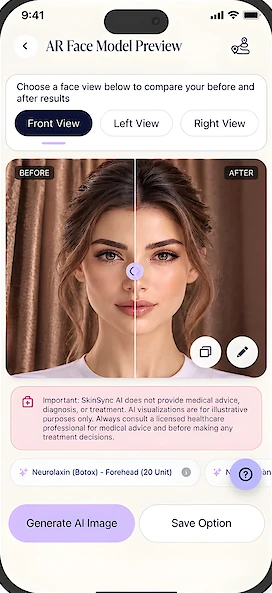
No. Sculptra and other biostimulators are not part of the SkinSync AI simulator. In the app you can see illustrative neurotoxin and dermal filler simulations today, find participating clinics and providers, and book a consultation.
In the SkinSync AI app
Find a clinic and book a consultation.
Sculptra is not part of the SkinSync AI simulator. In the app you can see simulations of neurotoxin and dermal filler treatments today (laser and energy-based treatments are coming soon), find participating clinics and providers with their availability and pricing, and book a consultation.
- Not simulated: Sculptra is not part of the app simulator
- Available now: scan your face and see illustrative neurotoxin and filler simulations from the front and both sides
- Find participating clinics and providers, with availability and pricing
- Book a consultation, in person or virtual, or a treatment directly in the app
- Save your scans and get reminders and aftercare guidance


Simulations are illustrative and do not predict results. The app does not give medical advice; a licensed provider determines appropriate treatment.

Sources
Every medical fact on this page is linked to one of these sources. Reviewed October 30, 2026.
- U.S. Food and Drug Administration: Sculptra, P030050/S039 (recently approved devices)
- U.S. Food and Drug Administration: Sculptra, Summary of Safety and Effectiveness Data, PMA P030050/S039 (2023)
- U.S. Food and Drug Administration: FDA-approved dermal fillers
- U.S. Food and Drug Administration: Dermal fillers (soft tissue fillers)
- American Society for Dermatologic Surgery: Injectable poly-L-lactic acid
- American Society for Dermatologic Surgery: Injectable calcium hydroxylapatite
- U.S. Food and Drug Administration: RADIESSE injectable implant, instructions for use for the dorsum of the hand (PMA P050052/S049)
- U.S. Food and Drug Administration PMA database: Radiesse (+) injectable implant, P050052/S129 (jawline contour, 2021)
- American Society of Plastic Surgeons: Dermal fillers
- American Society of Plastic Surgeons: How much do dermal fillers cost?
Related guides
Sculptra and Radiesse are trademarks of their respective owners. SkinSync AI is not affiliated with or endorsed by these companies.