
Planning: treatment guide
How to choose a provider for Botox, fillers and skin treatments
How do I choose a provider for an aesthetic treatment?
Look for a licensed physician with specialized training in the treatment you want, ideally a double board-certified plastic surgeon, facial plastic surgeon or dermatologist, or a licensed provider working under that kind of supervision. Check credentials, ask how often they perform the procedure, confirm they use FDA-approved products from authorized sources, and use the consultation to ask about risks, results and costs.[3][4][5][7]

Key points about choosing a provider
| Who | A licensed physician with specialized training in the procedure, ideally a double board-certified plastic surgeon, facial plastic surgeon or dermatologist[3] |
|---|---|
| Why it matters | Cosmetic injections, fillers and laser procedures are legally classified as the practice of medicine[3] |
| Board certification | For plastic surgery, the American Board of Plastic Surgery (ABPS) is recognized by the American Board of Medical Specialties (ABMS)[1] |
| Experience | Ask how many times your provider has performed the exact procedure[2][4] |
| Products | FDA-approved product in properly labeled, sealed vials or prefilled syringes, from an authorized source[6][7] |
| Consultation | Medical history, goals, a personalized plan, and openness about risks, results and costs[3] |
| Aftercare | Know what complications to watch for and who to contact, including after hours[3] |
| Price | Varies by clinic and area. Be cautious of prices that seem too good to be true.[3] |
Board certification and training
Because outcomes depend largely on the skill and experience of the person performing the procedure, it is important to choose a board-certified physician.[4] Board-certified dermatologists may have the initials FAAD after their name.[4]
The first and most important choice is a double board-certified plastic surgeon. Look for one who is certified by the American Board of Plastic Surgery or the Royal College of Physicians and Surgeons of Canada, has completed at least six years of surgical training after medical school including at least three years of plastic surgery residency, and operates in accredited, state-licensed or Medicare-certified facilities.[1]
Do not be confused by other official-sounding boards: there is no ABMS-recognized certifying board with "cosmetic surgery" in its name.[1]
Only three medical specialties, plastic surgery, facial plastic surgery and dermatology, require comprehensive training in the treatments typically offered at a med spa.[3]
Med spas and who actually treats you
Many people get Botox, fillers or laser treatments at a medical spa. The gold standard is a med spa run by a physician with specialized training in the treatments offered. Some are run by doctors from unrelated specialties or by non-physicians who may have less training in the anatomy involved.[3]
- Verify the credentials of the medical director, the supervising physician and anyone who may perform your treatment.[3]
- Check staff bios to confirm each provider is a licensed medical professional.[3]
- Make sure the person doing your procedure is named in advance, and that you are not switched to someone else on the day.[3]
- Procedures should be supervised by a physician in line with your state's laws, which vary.[3]
- Avoid any med spa procedure that needs more than local anesthesia or light sedation; those belong in a licensed surgical center or hospital.[3]
Products and safety
For fillers, the FDA advises working with a licensed health care provider who has experience in dermatology or plastic surgery and is trained to inject fillers, and treating filler injection as a medical procedure.[5][6] The provider should use properly labeled, sealed vials or prefilled syringes of FDA-approved filler, and you can ask for the patient labeling information.[6]
The FDA has warned about counterfeit Botox given in non-medical or unlicensed settings and bought from unlicensed sources, linked to serious adverse events. It advises confirming that your product comes from an authorized source and asking whether your provider is licensed and trained to give it.[7]
The FDA has not approved needle-free devices for injecting fillers, and it warns against buying fillers sold directly to the public or injecting yourself.[5][6]
The most serious filler risk is accidental injection into a blood vessel, which can cause tissue death, stroke or blindness. The FDA notes that an experienced provider should be knowledgeable about anatomy and managing complications.[6] Safe filler use requires specialized training and a thorough understanding of facial anatomy.[8]
Making the most of the consultation
A quality practice should offer a thorough consultation before any treatment, covering your medical history, your goals and a personalized plan, and should be open about risks, expected results and costs.[3] You should be asked to sign an informed consent form before any procedure.[3]
Before you go, ask yourself what you want from the procedure, how much downtime and risk you are willing to accept, and what you can pay.[4] Before-and-after photos can help, but credentials, experience and referrals should outweigh marketing photos. See Before and after: what to expect for how to read them.[3][9]
Questions to ask your provider
These questions come from dermatology and plastic surgery consultation checklists:[2][4]
- Are you board certified, and by which board?[2][4]
- What is your experience with this procedure, and how many have you performed?[2][4]
- How often do you treat patients with my skin tone and type, and in my age range?[4]
- Is this procedure the best option for me, and am I a good candidate?[2][4]
- What results can I realistically expect, and do you have before-and-after photos?[2][4]
- What are the risks, and how are complications handled?[2][4]
- How long will it take, how many treatments will I need, and what is the recovery time?[4]
- Which product will you use, and where will each product be injected?[6]
- What complications should I watch for, and who do I contact after hours?[3]
- What will it cost in total?[3][4]
For more on price, see What Botox and filler cost.
Warning signs
- Prices that seem too good to be true, which may point to lower-quality products or less experienced providers.[3]
- Unclear pricing or hidden fees.[3]
- A provider you cannot identify in advance, or credentials you cannot verify.[3]
- Products sold directly to you, or offered for you to inject yourself.[5][6]
- Needle-free "pens" for filler injection.[6]
- Injections in a non-medical setting, or product of unknown origin.[7]
- Treatments that seem complex, invasive or beyond the training of the staff on site.[3]
Frequently asked questions about choosing a provider
Who should give me Botox or filler?
A licensed health care provider trained in the procedure, ideally a physician with specialized training such as a double board-certified plastic surgeon, facial plastic surgeon or dermatologist, or someone working under that supervision.[3][5]
What does board certified mean?
It means certification by a recognized specialty board. For plastic surgeons, look for certification by the American Board of Plastic Surgery, which is recognized by the American Board of Medical Specialties.[1]
Is a "board-certified cosmetic surgeon" the same thing?
Not necessarily. There is no ABMS-recognized certifying board with "cosmetic surgery" in its name.[1]
Is it safe to get treated at a med spa?
It can be, if the med spa is overseen by a licensed physician with specialized training, the person treating you is a licensed professional, and the practice follows your state's supervision rules.[3]
How do I know my Botox is genuine?
Ask your provider to confirm the product comes from an authorized source and that they are licensed and trained to give it. The FDA has warned about counterfeit Botox bought from unlicensed sources.[7]
Can I buy filler and inject it myself?
No. The FDA advises against injecting yourself and warns that fillers sold directly to the public may be fake, contaminated or not approved for use in the U.S.[5][6]
What should happen at a consultation?
The provider should review your medical history and goals, propose a personalized plan, and be open about risks, expected results and costs. You should sign an informed consent form before any procedure.[3]
Should I pick the cheapest clinic?
Cost should not be your only deciding factor. Extremely low prices may mean lower-quality products or less experienced providers.[3]
How much do before-and-after photos matter?
They help you see a provider's previous work, but credentials, experience and referrals should outweigh marketing photos.[3]
Can the SkinSync AI app pick a provider for me?
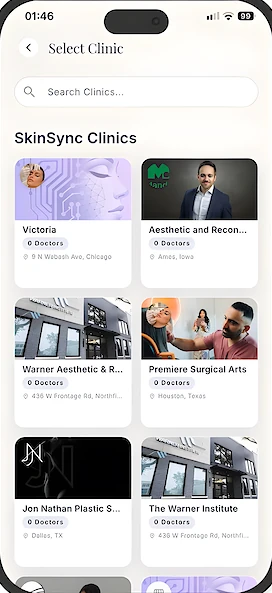
No. The app helps you find participating clinics and providers with their availability and pricing, and book a consultation. The app does not give medical advice; a licensed provider determines appropriate treatment.
SkinSync AI: Aesthetic Care
Find a clinic and arrive prepared.
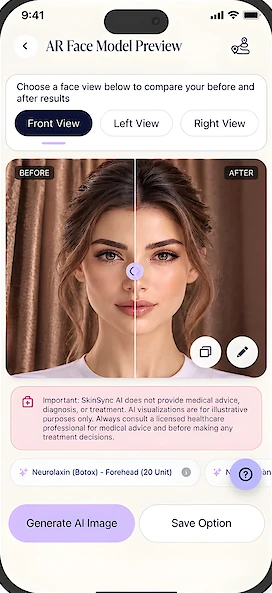
Choosing a provider is your decision; the app helps you research. In the app you can see simulations of neurotoxin and dermal filler treatments today (laser and energy-based treatments are coming soon), find participating clinics and providers with their availability and pricing, and book a consultation.
- Scan your face and see an illustrative neurotoxin or dermal filler simulation from the front and both sides
- Find participating clinics and providers, with availability and pricing
- Book a consultation, in person or virtual, or a treatment in the app
- Save your scans and get reminders and aftercare guidance


Simulations are illustrative and do not predict results. The app does not give medical advice; a licensed provider determines appropriate treatment.
Sources
Every medical fact on this page is linked to one of these sources. Reviewed October 30, 2026.
- American Society of Plastic Surgeons: Choose a Plastic Surgeon You Can Trust
- American Society of Plastic Surgeons: Questions to Ask Your Plastic Surgeon
- American Society of Plastic Surgeons: How to Choose the Right Medical Spa for You
- American Academy of Dermatology: Best questions to ask when considering a cosmetic treatment
- U.S. Food and Drug Administration: Dermal Fillers (Soft Tissue Fillers)
- U.S. Food and Drug Administration: Dermal Filler Do's and Don'ts for Wrinkles, Lips and More
- U.S. Food and Drug Administration: Counterfeit Version of Botox Found in Multiple States
- American Society of Plastic Surgeons: Dermal fillers cost and choosing a professional
- American Society of Plastic Surgeons: Can you trust that transformation? Reading before and after photos in the age of AI
Related guides
Botox is a trademark of its owner. SkinSync AI is not affiliated with or endorsed by this company.