
Planning: treatment guide
Before and after: what to expect, and how to read the photos
What should I expect before and after an aesthetic treatment?
It depends on the treatment. Botox-type injections take days to show and up to two weeks to fully settle, most fillers show right away but can look swollen at first, and laser and microneedling results build over months. Before-and-after photos can help you understand a provider's work, but lighting, angles, timing and editing all change what you see, so they are one part of your research, not a promise.[1][2][6][7][8][10][13]

Key points about before and after
| Neurotoxins | Noticeable around day 3 or 4; full effect within 10 to 14 days; lasts about 3 to 4 months[5][6] |
|---|---|
| Most fillers | Immediate or close to immediate; poly-L-lactic acid shows in 2 or 3 weeks[7] |
| Right after filler | Can look overfilled, swollen or bruised at first; most of this improves within hours to a few days[8] |
| Laser resurfacing | Skin may stay red or pink for up to several months and can keep improving for up to a year[10] |
| RF microneedling | Best results typically 3 to 6 months after the first treatment[13] |
| Photo basics | Before and after should match in lighting, angle, pose, makeup and distance[1][2] |
| Editing | Photos may be digitally enhanced or retouched[1] |
| Everyone differs | Healing and outcomes vary with age, skin type, health and aftercare[1] |
Timelines by treatment
Each treatment changes the face on its own schedule, so an "after" photo means little without knowing when it was taken. Here is what authoritative sources say about timing. Each guide linked below has the full detail.[2]
Swipe sideways to see all columns.
| Treatment | When change shows | How long it lasts |
|---|---|---|
| Botox and other neurotoxins | Around the third or fourth day; full results within 10 to 14 days[6] | About 3 to 4 months, sometimes longer[5] |
| Hyaluronic acid and most fillers | Immediate or close to immediate[7] | Depends on the filler material and the area injected[9] |
| Poly-L-lactic acid filler | 2 or 3 weeks[7] | Depends on the material and area[9] |
| Laser skin resurfacing | Some people see an immediate difference that keeps improving for up to a year[10] | Effects can last many years, though normal aging continues[10] |
| Laser treatment for scars | Can take months; little improvement at first[12] | Ask your provider |
| RF microneedling | Best results typically 3 to 6 months after the first treatment[13] | Ask your provider |
The first days and weeks
After neurotoxin injections
Most people notice the effect within the first few days, and full results are usually visible within about two weeks. Within three to six months the toxin wears off, muscles regain movement and lines return unless you are treated again.[6] A photo taken the day after treatment does not yet show the full effect.
After filler
Right after any dermal filler, the treated area may look overfilled, with swelling or bruising, temporary numbness or redness, or lumps at the injection sites. Most of this improves within hours or a few days.[8] Results depend on the underlying tissue structure and the volume and type of filler used.[9]
After laser resurfacing
Skin may stay red or pink for up to several months and be extra sensitive to sunlight for up to a year.[10] Depending on the treatment, redness can last from a few weeks to several months.[11] Results continue to improve for up to a year, so an early photo and a later one can look quite different.[10]
How to read before-and-after photos
Before-and-after photos are part of clinical documentation, and for patients they are one of the clearest ways to understand a provider's aesthetic and consistency.[2] Check them for these things:
- Same lighting, angle and pose. The before and after should match in lighting, camera distance, head position, facial expression, makeup, hairstyle and image scale.[1][2]
- Posture and position. Chin position, neck extension, posture and camera angle can make an after photo look better without any real treatment difference.[2]
- Signs of editing. Photos may be digitally enhanced or retouched. Watch for strange skin texture, warped backgrounds, inconsistent shadows or proportions that look too good to be true.[1][2]
- Timing. A result at six weeks is different from a result at one year, so ask when each photo was taken.[1][2]
- Several views. Look at front, profile and three-quarter views, not just the most flattering one.[2]
- A body of work. Many cases photographed the same way over time say more than a single striking image.[2]
- The source. Photos on a qualified provider's own practice website are different from heavily filtered images on social media.[2]
- More than one provider. Compare photos from several providers to understand what a procedure can do.[1]
Setting realistic expectations
People heal differently, and outcomes are influenced by age, skin type, health and how closely aftercare instructions are followed. What works well for one person may not for another, so someone else's photos cannot predict how you will look.[1]
Dermatologists recommend not overdoing fillers, and a conservative approach tends to look more natural.[7] Ask to see photos of patients with a similar skin tone and type to yours.[3]
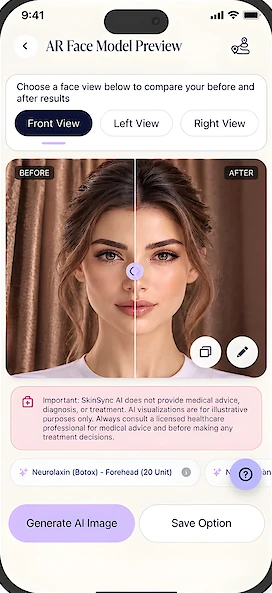
A simulation in the SkinSync AI app is a different thing again: it is an illustration to help you explain what you have in mind, not a before-and-after result. A licensed provider decides what is appropriate for you.
Questions to ask about before-and-after photos
- Do you have before-and-after photos for this procedure, and what results are reasonable for me?[4]
- What results can I realistically expect? Can I see photos of patients with a similar skin tone and type?[3]
- How long after treatment was each photo taken, and are these typical outcomes?[1]
- How many treatments will I need, and what is the typical recovery time?[3]
For more on choosing a qualified provider, see How to choose a provider.
Frequently asked questions about before and after
When will I see a change after Botox?
Most people notice the effect around the third or fourth day, with full results visible within 10 to 14 days.[6]
Do fillers show right away?
Most fillers produce immediate or close to immediate results. Poly-L-lactic acid takes 2 or 3 weeks.[7]
Why do my lips or cheeks look bigger right after filler?
Right after filler the area can look overfilled, swollen or bruised. Most of this improves within hours or a few days.[8]
How long until I see laser resurfacing results?
Some people see a difference right away, and it keeps improving for up to a year. Redness can last several months.[10][11]
Are before-and-after photos reliable?
They can be useful, but there is no industry-wide standard for taking them, and some may be retouched. Check that lighting, angle and pose match, and ask how long after treatment they were taken.[1]
How can I tell if a photo has been edited?
Look for strange skin texture, warped backgrounds, inconsistent shadows or proportions that look too good to be true. Consistency across many cases matters more than any single image.[2]
Should I trust photos on social media?
Be careful. Highly filtered images may not reflect what a procedure can do. Photos on a qualified provider's practice website are a better starting point.[2]
Will I look like the patients in the photos?
Not necessarily. People heal differently, and age, skin type, health and aftercare all affect outcomes.[1]
Does the SkinSync AI app show before-and-after results?
No. The app shows illustrative simulations of neurotoxin and dermal filler treatments. Simulations are illustrative and do not predict results. A licensed provider determines appropriate treatment.
SkinSync AI: Aesthetic Care
See a simulation before you book.
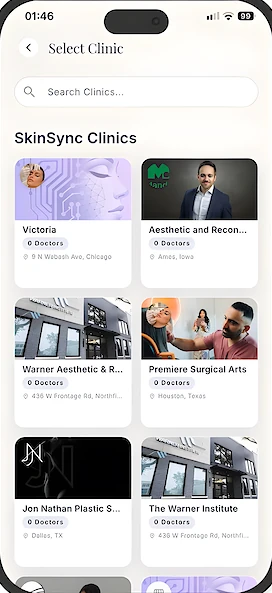
The app shows simulations, not before-and-after results. In the app you can see simulations of neurotoxin and dermal filler treatments today (laser and energy-based treatments are coming soon), find participating clinics and providers with their availability and pricing, and book a consultation.
- Scan your face and see an illustrative neurotoxin or dermal filler simulation from the front and both sides
- Find participating clinics and providers, with availability and pricing
- Book a consultation, in person or virtual, or a treatment in the app
- Save your scans and get reminders and aftercare guidance


Simulations are illustrative and do not predict results. The app does not give medical advice; a licensed provider determines appropriate treatment.
Sources
Every medical fact on this page is linked to one of these sources. Reviewed October 30, 2026.
- American Society of Plastic Surgeons: Can you trust before and after photos?
- American Society of Plastic Surgeons: Can you trust that transformation? Reading before and after photos in the age of AI
- American Academy of Dermatology: Best questions to ask when considering a cosmetic treatment
- American Society of Plastic Surgeons: Questions to Ask Your Plastic Surgeon
- American Academy of Dermatology: Botulinum toxin therapy, overview
- Clinical, Cosmetic and Investigational Dermatology: Botulinum toxin (Botox) A for reducing the appearance of facial wrinkles: a literature review of clinical use and pharmacological aspect (2019)
- American Academy of Dermatology: Fillers, FAQs
- American Society of Plastic Surgeons: Dermal fillers recovery
- U.S. Food and Drug Administration: Dermal Fillers (Soft Tissue Fillers)
- American Society of Plastic Surgeons: Laser skin resurfacing results
- StatPearls (NCBI Bookshelf): Ablative Laser Resurfacing (2023)
- American Academy of Dermatology: Laser treatment for scars, what to expect
- Journal of Cosmetic Dermatology: Radiofrequency Microneedling for Facial Rejuvenation: A Systematic Review (2026)
Related guides
Botox, Fraxel and Morpheus8 are trademarks of their respective owners. SkinSync AI is not affiliated with or endorsed by these companies.