
Skin treatments: treatment guide
PRP facial (vampire facial): what it is, results, side effects and cost
What is a PRP facial?
A PRP facial, often called a vampire facial, uses platelet-rich plasma (PRP) made from a small amount of your own blood. The blood is spun in a centrifuge to concentrate the platelets, and the PRP is then injected into the face or applied to the skin during microneedling.[1][2][3] Dermatologists say there is still little evidence to show whether it works, so results are unpredictable.[1]

PRP facial quick facts
| What it is | Platelet-rich plasma prepared from your own blood, injected into the skin or applied during microneedling[1][2] |
|---|---|
| What it may help | Patients report less sagging, fewer wrinkles and creases, a better complexion and less noticeable acne scars, but evidence is limited[1] |
| Strength of evidence | Studies are few and mostly small or uncontrolled; reviews say the evidence is not strong enough for firm conclusions[1][4][5] |
| Treatment time | About 45 minutes to one hour, including the blood draw[1] |
| Downtime | Little to none for most people[1] |
| Typical sessions | Most people who see results have 3 or more treatments[1] |
| Results timeline | If results appear, the full effect shows within a few weeks to months[1] |
| How long it lasts | Results can last as long as 18 months[1] |
| Cost | Varies by clinic and area. Depends on the provider, location and how many sessions you have. |
| Insurance | Treatment to improve appearance is not covered[1] |
How a PRP facial works
Platelets are cells in your blood that help it clot. They also carry growth factors, which play a part in healing.[2][3] To make PRP, a provider draws a small amount of your blood, about 2 to 4 tablespoons, and spins it in a centrifuge. This separates the blood into layers, and the layer with a high concentration of platelets is collected.[1][2] Concentrating the platelets also concentrates the growth factors.[3]
The PRP is then injected into the face with a syringe, or applied to the skin during microneedling, where tiny needles help the skin absorb it.[1][2] PRP is thought to encourage collagen and elastin, the proteins that give skin its structure and stretch.[2]
PRP is used in other areas of medicine, such as sports injuries and wound care, and is being studied for hair loss.[1][4] For the face, there is little evidence to show that it works, or that it does not. Because PRP uses needles and a centrifuge, the FDA classifies it as a medical device, which does not require the large studies needed for new drugs.[1]
A 2018 review in a plastic surgery journal found that the published facial studies all reported positive results, but that they varied widely in how PRP was prepared and injected and often lacked comparison groups and long-term follow-up.[4] A 2024 overview of systematic reviews concluded that the evidence is insufficient to draw firm conclusions about PRP for facial rejuvenation, alone or combined with other treatments.[5]
What to expect, step by step
- Before your consultation: explore the appIf you like, use the SkinSync AI app to browse participating clinics and providers. The app does not simulate PRP facials, and your provider decides what is appropriate for you.
- ConsultationYour provider reviews your health history and current medicines to see whether PRP is suitable for you and talks through your goals.[2] The AAD recommends seeing a board-certified dermatologist if you are considering PRP.[1]
- PreparationYour provider may ask you to stop anti-inflammatory medicines such as NSAIDs before treatment.[2] Follow your own provider's instructions.
- Blood drawA small amount of blood is drawn, usually from your arm, and spun in a centrifuge to separate the PRP.[1][2]
- TreatmentThe PRP is injected into the face or applied during microneedling.[1][2] The whole visit takes about 45 minutes to one hour.[1]
- Right afterExpect some pain, bruising and swelling, which tend to go away within a few days.[1]
- Results and follow-upIf PRP works for you, the full effect appears within a few weeks to months. Most people who see results have 3 or more treatments.[1]
Side effects and who should avoid a PRP facial
Common side effects
The procedure itself appears safe.[1] Side effects can include:
- Pain, bruising and swelling, which tend to go away within a few days[1]
- Pain or tenderness at the injection site[2]
- Changes in skin tone, red or dark brown
If PRP is combined with hyaluronic acid filler (a PRP facelift), filler can rarely cause bumps, pain or persistent swelling, and filler injected into a blood vessel can cause tissue in the area to die.[2] See the dermal fillers guide for more on filler safety.
Serious but rare: infection from unsafe blood handling
The biggest risk comes from how your blood is handled. It must be kept sterile to avoid infection, and the facility should follow the same process transfusion centers use to make sure you receive only your own blood.[1] In 2024 the CDC reported a cluster of HIV infections linked to PRP microneedling facials at an unlicensed spa in New Mexico that did not follow recommended infection control practices.[6]
Who should avoid a PRP facial or talk to a provider first
- Hepatitis C or HIV[1][2]
- Any type of blood cancer[1]
- A bleeding or clotting disorder
- Taking a blood thinner, including for heart disease[1][2]
- Skin cancer in the area to be treated[1][2]
Choose a licensed medical setting
Choose an experienced provider such as a double board-certified plastic surgeon or dermatologist.[2] The CDC investigation found that the unlicensed spa did not keep client records, and recommends adequate infection control and record keeping at spas that offer cosmetic injections.[6] Our guide to choosing a provider lists questions to ask.
PRP facial aftercare
Your provider will give you instructions for your skin.
- Ice for swelling. Use an ice pack wrapped in a towel as needed.
- Pain relief. Over-the-counter pain relievers such as acetaminophen can help, taken as directed.
- Sleep with your head raised, on your back, at first.
- Skip some things for a while: sun exposure, heavy lifting, strenuous exercise and heavy creams, and avoid washing your face or wearing makeup for a day.
- Call your provider about bleeding, excessive bruising, pain or swelling that does not go away.
For aftercare across other treatments, see our aftercare guide.
Vampire facial vs PRP facelift
The names sound alike, but they are different procedures.
Swipe sideways to see both procedures.
| Vampire facial | PRP facelift | |
|---|---|---|
| What is done | PRP is spread over the face, then microneedling or tiny pricks help the skin absorb it[2] | PRP injections combined with hyaluronic acid filler injections[2] |
| What it targets | Surface concerns such as acne scars, fine lines, large pores, pigmentation and rough texture[2] | Brightening, contour, texture, wrinkles, plumper skin and acne scars[2] |
| When changes show | If results appear, within a few weeks to months[1] | Plumping from the filler right away; smoothing from the PRP after about two weeks[2] |
| How long it lasts | Results can last as long as 18 months[1] | About 12 to 18 months[2] |
Both rely on PRP, whose evidence for facial rejuvenation is still limited.[4][5] Which option suits you, if any, is a decision to make with a licensed provider. You can also read about microneedling on its own and radiofrequency microneedling (Morpheus8).
Frequently asked questions about PRP facials
Does a PRP facial work?
Some people see less sagging and fewer wrinkles, but there is little evidence to show whether it works and that results are unpredictable.[1] A 2024 overview of systematic reviews found the evidence insufficient for firm conclusions.[5]
Why is it called a vampire facial?
Because it uses your own blood. The blood is processed into platelet-rich plasma, which is then applied to or injected into your face.[2]
How many PRP facial sessions will I need?
Researchers have found that most people who get results have 3 or more treatments.[1] For a PRP facelift, some providers recommend three sets of injections, one a month for three months.[2]
How long do PRP facial results last?
Results can last as long as 18 months.[1] Expect about 12 to 18 months for a PRP facelift.[2]
Is a PRP facial painful?
For a PRP facelift, numbing cream is applied to the skin first. You may have some pain, bruising and swelling afterwards, which tend to go away within a few days.[1][2]
Is there downtime after a PRP facial?
There is little to no downtime, and most people can return to regular activities right away.[1][2]
Is a PRP facial safe?
The procedure itself appears safe, but the biggest risk comes from how your blood is handled: it must stay sterile, and you must receive only your own blood.[1] HIV infections have been linked to PRP facials at an unlicensed spa that did not follow infection control practices.[6]
Who should not get a PRP facial?
It is not recommended for people with hepatitis C, HIV, a blood cancer, a bleeding or clotting disorder, skin cancer in the treatment area, or who take a blood thinner.[1][2]
Is a PRP facial FDA approved?
Because PRP uses needles and a centrifuge, the FDA classifies it as a medical device, and the large studies required for new drugs are not required.[1]
Is a PRP facial covered by insurance?
No. Because it is done to improve appearance, medical insurance does not cover it.[1]
SkinSync AI: Aesthetic Care
Plan your next step in the app.
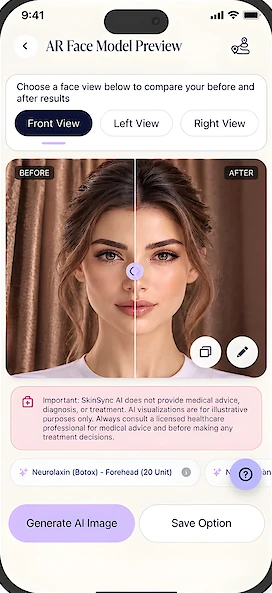
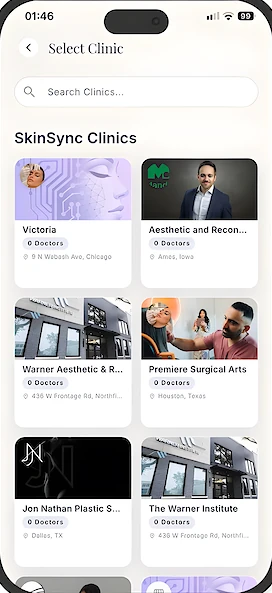
The PRP facial is not part of the SkinSync AI simulator. In the app you can see simulations of neurotoxin and dermal filler treatments today (laser and energy-based treatments are coming soon), find participating clinics and providers with their availability and pricing, and book a consultation.
- Scan your face and see an illustrative neurotoxin or dermal filler simulation from the front and both sides
- Find participating clinics and providers, with availability and pricing
- Book a consultation, in person or virtual, or a treatment in the app
- Save your scans and get reminders and aftercare guidance


Simulations are illustrative and do not predict results. The app does not give medical advice; a licensed provider determines appropriate treatment.
Sources
Every medical fact on this page is linked to one of these sources. Reviewed October 30, 2026.
- American Academy of Dermatology: Is platelet-rich plasma the secret to younger-looking skin?
- Skin Research and Technology: Use of platelet rich plasma for skin rejuvenation (2024); U.S. Food and Drug Administration: Dermal Fillers (Soft Tissue Fillers)
- Journal of Cutaneous and Aesthetic Surgery: Principles and Methods of Preparation of Platelet-Rich Plasma: A Review and Author's Perspective (2014)
- American Society of Plastic Surgeons: Platelet-rich plasma for cosmetic facial procedures, promising results but evidence has limitations (2018)
- Cruciani M, et al. Platelet rich plasma for facial rejuvenation: an overview of systematic reviews. Blood Transfusion, 2024 (PubMed)
- Stadelman-Behar AM, et al. Investigation of presumptive HIV transmission associated with receipt of platelet-rich plasma microneedling facials at a spa among former spa clients. CDC Morbidity and Mortality Weekly Report, 2024 (PubMed)
Related guides
HydraFacial and Morpheus8 are trademarks of their respective owners. SkinSync AI is not affiliated with or endorsed by these companies.