
Dermal fillers: treatment guide
Jawline filler: what it is, results, side effects and cost
What is jawline filler?
Jawline filler is an injection of a dermal filler, placed deep under the skin or on top of the bone along the jaw, to improve jawline definition or contour. The FDA has approved Juvederm Volux XC, a hyaluronic acid filler, and Radiesse (+), a calcium hydroxylapatite filler, for the jawline in adults over 21. Results are temporary because the filler is absorbed over time.[1][2][3][4]

Jawline filler quick facts
| What it is | An injectable dermal filler, a medical device implant, placed along the jaw to improve its definition or contour[1][3][4] |
|---|---|
| FDA-approved products for the jawline | Juvederm Volux XC (a hyaluronic acid filler) for moderate to severe loss of jawline definition, and Radiesse (+) (calcium hydroxylapatite) for moderate to severe loss of jawline contour, both in adults over 21[3][4] |
| Where it is placed | Deep injection, under the skin and/or on top of the bone (supraperiosteal)[3][4] |
| How long it lasts | Temporary. In clinical trials, Juvederm Volux XC restored jawline definition through 1 year, and Radiesse (+) improvements were reported through 48 to 60 weeks[5][7] |
| Treatment time | About 15 minutes to an hour, depending on how many areas are treated[8] |
| Downtime | Most activities can be resumed right away; avoid intense physical activity for the first 24 to 48 hours[9] |
| Typical sessions | Repeat treatments are needed at intervals to maintain the correction[1][10] |
| Cost | Varies by clinic and area. Depends on the provider, the type of filler and procedure, the time involved and location.[11] |
| Insurance | Dermal fillers are not covered by health insurance[11] |
How jawline filler works
Jawline filler is injected deep along the jaw to restore volume and improve the definition or contour of the jawline.[3][4][5] Loss of jawline contour is described as one of the early signs of aging, and not every case needs surgery.[6]
Two kinds of filler are FDA approved for the jawline. Hyaluronic acid is a type of sugar naturally present in skin and cartilage that binds water and swells in gel form, creating a filling effect. Calcium hydroxylapatite is a mineral-like compound found in human teeth and bones; in a filler, its particles are suspended in a gel.[2][12]
Which fillers are FDA approved for the jawline?
The FDA approves dermal fillers product by product and area by area, so not every filler is approved for every part of the face.[1] Two products carry an FDA approval for the jawline:
- Juvederm Volux XC (hyaluronic acid): subcutaneous and/or supraperiosteal injection to improve jawline definition in adults over 21 with moderate to severe loss of jawline definition[3]
- Radiesse (+) (calcium hydroxylapatite with lidocaine): deep injection (subdermal and/or supraperiosteal) to improve moderate to severe loss of jawline contour in adults over 21[4][6]
What the studies found
In a randomized trial of Juvederm Volux XC (studied as VYC-25L), 69 percent of treated participants improved by at least one grade on a jawline definition scale at month 6, compared with 38 percent of the control group. Most injection site reactions were mild or moderate and resolved within 2 weeks, and the study concluded the filler restores jawline definition through 1 year.[5]
In a randomized trial of Radiesse (+), 75.6 percent of treated patients improved by at least one point on a jawline scale at week 12, compared with 8.8 percent of the untreated control group.[6] In longer follow-up, 62.9 percent were still responders at 48 weeks.[7]
Jawline filler is one of several dermal filler treatments, and it is often considered together with chin filler when the goal is a more balanced lower face.
What to expect, step by step
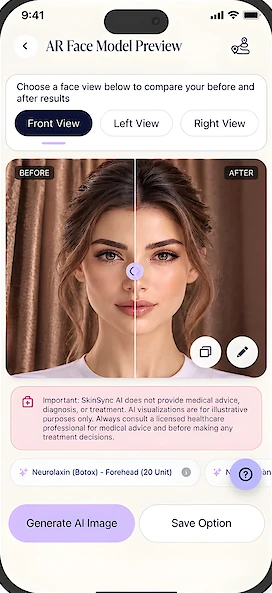
- Before your consultation: preview it in the appIf you like, scan your face in the SkinSync AI app and look at an illustrative jawline filler simulation, so you can show your provider what you have in mind. A simulation does not predict your outcome, and your provider decides what is appropriate for you.
- Choose a qualified providerThe FDA recommends a licensed health care provider with experience in dermatology or plastic surgery who is trained to inject fillers. Ask which product will be used, whether it is approved for the jawline, and read its patient labeling.[1]
- Consultation and mappingYour provider evaluates your face and the area to be treated. Injection points may be marked, and photos may be taken.[8] Mention any bleeding disorder, severe allergies, allergy to lidocaine, or active skin inflammation or infection.[1]
- Cleansing and numbingThe skin is cleansed with an antibacterial agent. Discomfort can be eased with a cold instrument, a numbing ointment or local anesthetic. The injections are not painless but are usually easily tolerated.[8]
- InjectionEach injection takes only a few moments. Your provider injects, massages and evaluates, adding filler as needed. The whole visit can take 15 minutes to an hour.[8]
- Right afterYou may be offered an ice pack. The area can feel tender for a day or two, and swelling, bruising, redness, temporary numbness or small lumps can appear at first. Most of this improves within hours or a few days.[8][9]
- MaintenanceFillers are absorbed over time, so treatment is repeated at intervals to keep the correction. How long it lasts depends on the filler material and the area injected.[1][10]
Side effects and who should avoid jawline filler
Common side effects
Most side effects, such as swelling and bruising, appear shortly after the injection and many go away within a few days to weeks.[1] The FDA lists these common risks:
Other possible problems include lumps or filler you can feel under the skin, asymmetry, and under- or over-correction.[10] Less commonly, swelling or redness can flare near the injection site after a viral or bacterial illness, a vaccination or a dental procedure, and raised bumps (nodules or granulomas) can form that may need treatment. Infection and allergic reactions are also possible, and some side effects can appear weeks, months or years after the injection.[1]
Calcium hydroxylapatite is visible on x-rays and may obscure underlying features.[2] It is produced without animals or animal products, and no skin allergy test is required.[12]
Serious but rare: injection into a blood vessel
The most concerning risk of any dermal filler is unintended injection into a blood vessel, which can block blood flow. The chance is low, but complications can be serious and may be permanent, including tissue death (necrosis), vision problems including blindness, and stroke.[1][10] Get medical help right away if you have unusual pain, vision changes, skin near the injection site that turns white, gray or blue, or any sign of a stroke during or shortly after treatment.[1]
Who should avoid jawline filler or talk to a provider first
- Under 22: fillers are approved for adults 22 and older, and safety in younger people is unknown[1]
- Pregnant or breastfeeding: safety is unknown[1]
- Prone to keloids or thick scars: safety is unknown[1]
- Active skin inflammation or infection such as cysts, pimples, rashes or hives: treatment should be delayed until it is managed[1]
- Bleeding disorder, severe allergies or a history of anaphylaxis[1]
- Allergy to lidocaine or to bacteria-derived ingredients (some hyaluronic acid is made by bacterial fermentation)[1]
The FDA also advises never injecting yourself with filler and never buying filler online, because products may be counterfeit or not approved in the U.S.[1]
Aftercare
- Avoid intense physical activity for the first 24 to 48 hours to help limit swelling and bruising[9]
- Icing can help with swelling and tenderness; follow your provider's instructions on icing and massage[9]
- Follow the specific recovery plan your provider gives you, since recovery varies by person and by filler[9]
- Swelling or redness near the site can flare after an illness, a vaccination or a dental procedure, so let your provider know if this happens[1]
- Seek care immediately for visual disturbances, especially with pain or weakness on one side of the body[9]
Jawline filler vs Botox masseter reduction
Both treatments change the shape of the lower face, but they work in opposite ways. Jawline filler adds volume to improve the definition or contour of the jaw.[3][4] Masseter reduction uses botulinum toxin to relax the masseter, the large chewing muscle at the angle of the jaw. An enlarged masseter can widen the lower face, and botulinum toxin type A injection is a nonsurgical option for slimming it.[13]
| Jawline filler | Botox masseter reduction | |
|---|---|---|
| Goal | Add volume and definition along the jaw[3][4] | Slim a lower face widened by an enlarged masseter muscle[13] |
| How it works | A filler gel placed under the skin and/or on the bone[3][4] | Botulinum toxin relaxes the masseter muscle[13] |
| FDA status for this use | Juvederm Volux XC and Radiesse (+) are FDA approved for the jawline[3][4] | Masseter reduction is not among the cosmetic uses on the Botox Cosmetic FDA label[14] |
| When it shows | Right after treatment, once early swelling settles[8][9] | Maximum effect is usually seen at about 3 months[13] |
| How long it lasts | Studies report effects through about 1 year[5][7] | Reported to last 6 to 12 months[13] |
| Main serious risk | Injection into a blood vessel[1] | Spread of toxin effect (boxed warning on the label)[14] |
A review of studies on masseter treatment found no standard guidelines for the procedure, and the best dose could not be determined because studies varied widely.[13] The FDA notes that the safety of dermal fillers used together with neuromodulators such as Botox has not been evaluated in controlled clinical studies.[1] Read more in our Botox guide.
Which approach suits you is a decision to make with a licensed provider.
Frequently asked questions about jawline filler
How long does jawline filler last?
It is temporary, and duration depends on the filler material and the area injected. In clinical trials, Juvederm Volux XC restored jawline definition through 1 year, and Radiesse (+) improvements were reported through 48 to 60 weeks.[1][5][7]
Is jawline filler FDA approved?
Yes, for specific products. Juvederm Volux XC is FDA approved to improve jawline definition, and Radiesse (+) is approved to improve jawline contour, both in adults over 21 with moderate to severe loss. The FDA approves different products for different areas, so ask your provider which filler they plan to use.[1][3][4]
Does jawline filler hurt?
The injections are not painless, but they are usually easily tolerated. Providers can numb the skin with a cold instrument, an anesthetic ointment or local anesthetic, and some fillers contain lidocaine.[2][8]
How much does jawline filler cost?
Varies by clinic and area. Your price depends on the provider, the type of filler and procedure, the time involved and your location. Health insurance does not cover dermal fillers.[11]
Is there downtime after jawline filler?
Very little for most people. You can resume most activities right away, but it is recommended to avoid intense physical activity for 24 to 48 hours. Swelling, bruising and tenderness usually improve within hours to a few days.[8][9]
What are the risks of jawline filler?
Common side effects include bruising, redness, swelling, pain, tenderness and itching. Rare but serious risks include injection into a blood vessel, which can cause tissue death, vision problems including blindness, or stroke.[1][10]
Jawline filler or Botox for a slimmer jaw?
They do different things. Filler adds volume to define the jawline, while botulinum toxin injected into the masseter muscle relaxes it to slim a lower face widened by an enlarged muscle. Masseter reduction is not among the cosmetic uses on the Botox Cosmetic FDA label.[3][4][13][14]
What is the difference between hyaluronic acid and calcium hydroxylapatite for the jaw?
Juvederm Volux XC is a hyaluronic acid filler and Radiesse (+) is a calcium hydroxylapatite filler; both are FDA approved for the jawline. Calcium hydroxylapatite is visible on x-rays. The FDA notes that fillers not made of hyaluronic acid can be harder to remove.[1][2][3][4]
Who should not get jawline filler?
Fillers are approved for adults 22 and older. Safety is unknown during pregnancy or breastfeeding and in people prone to keloids. Tell your provider about active skin inflammation or infection, bleeding disorders, severe allergies, or a lidocaine allergy.[1]
Can jawline filler be removed?
If filler needs to be removed or reduced, it may take injections, surgery or other treatments, which carry their own risks. The FDA notes removal can be difficult or impossible, especially for permanent fillers or fillers not made of hyaluronic acid.[1]
Can I preview jawline filler before I book?
Yes. The SkinSync AI app lets you scan your face and see an illustrative jawline filler simulation on a 3D model from the front and both sides. Simulations are illustrative and do not predict results; a licensed provider determines appropriate treatment.
SkinSync AI: Aesthetic Care
See a simulation before you book.
Read up here, then use the app to picture jawline filler on your own face and take the next step with a clinic. Arrive at your consultation informed and ready to ask the right questions.
- Scan your face and see an illustrative filler simulation from the front and both sides: jawline, chin, lips, cheeks, tear troughs, temples, nasolabial folds and more
- Find participating clinics and providers, with availability and pricing
- Book a consultation, in person or virtual, or a treatment in the app
- Save your scans and get reminders and aftercare guidance


Simulations are illustrative and do not predict results. The app does not give medical advice; a licensed provider determines appropriate treatment.

Sources
Every medical fact on this page is linked to one of these sources. Reviewed October 30, 2026.
- U.S. Food and Drug Administration: Dermal Fillers (Soft Tissue Fillers)
- U.S. Food and Drug Administration: FDA-Approved Dermal Fillers
- U.S. Food and Drug Administration, Premarket Approval database: Juvederm Volux XC, approval for jawline definition (P110033/S065)
- U.S. Food and Drug Administration, Premarket Approval database: Radiesse (+), approval for jawline contour (P050052/S129)
- Rivkin A, et al. Safe and Effective Restoration of Jawline Definition With VYC-25L. Aesthetic Surgery Journal, 2024
- Moradi A, et al. Effectiveness and Safety of Calcium Hydroxylapatite With Lidocaine for Improving Jawline Contour. Journal of Drugs in Dermatology, 2021
- Green JB, et al. Long-term duration and safety of Radiesse (+) for the jawline. Journal of Cosmetic Dermatology, 2024
- American Society of Plastic Surgeons: What are the steps of a dermal fillers procedure?
- American Society of Plastic Surgeons: Dermal fillers recovery
- American Society of Plastic Surgeons: What are the risks of dermal fillers?
- American Society of Plastic Surgeons: How much do dermal fillers cost?
- American Society of Plastic Surgeons: What types of dermal fillers are available?
- Kundu N, et al. Efficacy of botulinum toxin in masseter muscle hypertrophy for lower face contouring. Journal of Cosmetic Dermatology, 2022
- U.S. Food and Drug Administration approved prescribing information: BOTOX Cosmetic (onabotulinumtoxinA), via DailyMed, National Library of Medicine
Related guides
Botox, Juvederm, Volux and Radiesse are trademarks of their respective owners. SkinSync AI is not affiliated with or endorsed by these companies.