
Dermal fillers: treatment guide
Lip filler: what it is, results, side effects and cost
What is lip filler?
Lip filler is an injection that adds volume to the lips. It is a type of dermal filler, and most lip fillers are made of hyaluronic acid, a substance found naturally in the body that draws in moisture to plump the lips.[3][4] Lip augmentation is an FDA-approved use of dermal fillers in adults 22 and older.[1] Results typically last 12 to 18 months.[3]

Lip filler quick facts
| What it is | An injectable dermal filler that adds volume to the lips, most often hyaluronic acid[3][4] |
|---|---|
| FDA-approved uses | Lip augmentation, and small wrinkles around the mouth and lips (perioral lines), in adults 22 and older[1] |
| How long it lasts | Typically 12 to 18 months, depending on your age and metabolism[3] |
| Treatment time | From about 30 minutes to two hours, including numbing[3] |
| Numbing | A numbing cream or a nerve block injection[3][5] |
| Swelling | Usually goes down in 24 to 48 hours, but can take up to a week[3] |
| Downtime | Most people get back to normal activities quickly; avoid exercise for at least 24 hours[3][4] |
| Reversible? | Hyaluronic acid lip filler can be dissolved with an enzyme called hyaluronidase[3][8] |
| Cost | Varies by clinic and area. Depends on the provider, the product, the time the treatment takes and the location.[6] |
| Insurance | Not covered by health insurance[6] |
How lip filler works
Lip filler is a dermal filler injected into the lips. Hyaluronic acid, by far the most popular type for lips, attracts moisture. Drawing in and holding water plumps the lips, adding volume and fullness and helping smooth fine lines.[4] Brands of hyaluronic acid lip filler include Juvederm and Restylane.[3]
With age, the lips can lose volume.[3]
People choose lip filler to improve the size and shape of their lips or simply add fullness. Your provider may inject the edges of the lips (the vermilion border), the curve at the center of the upper lip (the Cupid's bow) and the corners of the mouth.[3]
Lip filler is a nonsurgical alternative to more invasive options, such as a lip implant or a lip lift.[3]
Who is a good candidate
What to expect, step by step
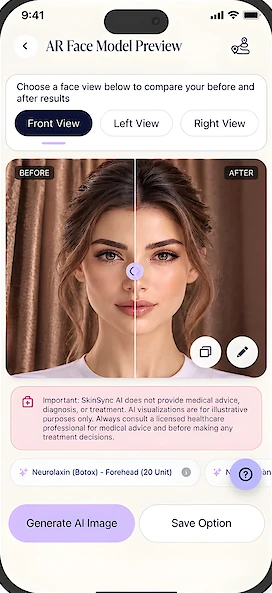
- Before your consultation: preview it in the appIf you like, scan your face in the SkinSync AI app and look at an illustrative lip filler simulation, so you can show your provider what you have in mind. A simulation does not predict your result, and your provider decides what is appropriate for you.
- ConsultationYour provider asks about your goals and reviews your health, allergies and medicines.[3]
- NumbingYour lips may be numbed before treatment, and some lip fillers contain the numbing agent lidocaine.[3]
- InjectionsYour provider uses a thin needle or a cannula to inject the filler.[3]
- Right afterYour lips may be swollen, tender and bruised.[3]
- Follow-upA follow-up visit lets your provider check your lips and whether you want more volume.[3]
- Planning around an eventLeave time before a big event for swelling and bruising to settle.[3]
- MaintenanceLip filler wears away over time, so touch-ups are needed to keep the volume.[3]
Side effects and who should avoid lip filler
Common side effects
After lip filler, your lips may be swollen, tender and bruised, with mild pain at the injection sites.[3] Other possible side effects include:
- Pain, redness, discoloration or tenderness at the injection sites[3]
- Uneven lips (asymmetry)[3]
- Reactivation of cold sores[3]
- Infection[3]
- Filler moving into nearby areas, usually toward the nose (migration)[3]
- Lumps or bumps under the skin[1]
Serious but rare: filler in a blood vessel
If lip filler is injected into or around an artery, it can block blood flow and cause tissue death (vascular compromise).[3] The FDA warns that filler injected into a blood vessel can also cause vision problems, including blindness, or stroke. The chances are low, but the harm can be permanent.[1]
Get medical help right away for unusual pain, vision changes, skin near the injection that turns white, gray or blue, or signs of a stroke during or shortly after treatment.[1]
Who should avoid lip filler or talk to a provider first
- Under 22. Fillers are not FDA approved for people under 22.[1]
- Pregnancy or breastfeeding. Safety is unknown, and there are no studies of lip filler during pregnancy.[1][3]
- Cold sores or another active infection around the mouth[3]
- A bleeding disorder[1]
- Allergies, including to lidocaine, which some fillers contain, or a history of severe allergic reactions[1]
- A tendency to form keloids or raised scars. Safety is unknown.[1]
Only get lip filler from a licensed provider
Get lip filler from an experienced provider, such as a plastic surgeon, dermatologist or cosmetic surgeon, not at a beauty salon or spa.[3] The FDA warns against lip fillers sold directly to the public and against needle-free "pens", which have caused serious and sometimes permanent injuries to the skin, lips and eyes.[2]
Lip filler aftercare
- Follow your provider's aftercare instructions to ease swelling and pain.[3]
- Ask your provider when you can use lip products such as lipstick or lip balm again.[3]
- Avoid pressing on or touching your lips while they heal.[3]
- Wait to eat until any numbness wears off, so you do not bite your lips.[3]
- Ask your provider how long to avoid exercise, smoking and alcohol after treatment.[3]
- Drink plenty of water and stay out of the sun after treatment.[3][5]
- Get emergency care for vision changes, skin turning white, gray or blue, or signs of a stroke.[1]
Lip filler vs Botox lip flip and other options
A lip flip uses a neurotoxin such as Botox instead of filler. Several small, low-dose injections at the lip line relax the muscle around the upper lip, so the lip turns slightly outward and looks fuller.[4][7] Lip filler adds actual volume. Plastic surgeons also offer fat grafting and a surgical lip lift.[4] Read more about neurotoxins in our Botox guide.
Swipe sideways to see all four options.
| Lip filler | Lip flip | Fat grafting | Lip lift | |
|---|---|---|---|---|
| What it is | Hyaluronic acid filler injected into the lips[4] | Small low-dose neurotoxin injections at the lip line[4] | Your own fat, taken by liposuction, purified and injected into the lips[4] | Surgery that shortens the space between the nose and the upper lip[4] |
| What it does | Adds volume and fullness and enhances shape and definition[4] | Relaxes the muscle so the upper lip appears fuller[4] | Adds volume[4] | Repositions the lip; can enhance the Cupid's bow[4] |
| How long it lasts | Typically 12 to 18 months[3] | Typically 2 to 3 months[4] | From five years to indefinitely in some patients[4] | A surgical change, not a temporary plumping[4] |
| Recovery | Can be minimal; some swelling or discoloration[4] | Some swelling possible; back to normal activities quickly[4] | Longer, because it involves liposuction[4] | The most invasive option[4] |
| Worth knowing | Hyaluronic acid filler can be dissolved with hyaluronidase[3][8] | Can cause some weakness around the mouth, for example when smiling or using a straw[4] | A surgical procedure[4] | Requires an incision below the nose[4] |
Which option suits you is a decision to make with a licensed provider. The SkinSync AI app can show illustrative simulations of both lip filler and a lip flip.
Frequently asked questions about lip filler
How long does lip filler last?
Lip filler typically lasts 12 to 18 months. How long it lasts depends on your age and metabolism, and it tends to last less long in younger people.[3] Ask your provider how long the product they recommend should last.
Does lip filler hurt?
Your lips are numbed first with a cream or a nerve block. You may feel pinching during the injections, and your eyes may water. Mild pain at the injection sites usually goes away after 12 to 24 hours.[3][5]
How long does lip filler swelling last?
Swelling usually goes away after 24 to 48 hours, but it can take up to a week. Book at least two weeks before a big event.[3]
Can lip filler be dissolved?
Yes, hyaluronic acid lip filler is reversible. A provider can inject an enzyme called hyaluronidase to dissolve it.[3][8]
Should I get lip filler or a lip flip?
Lip filler adds volume and typically lasts 12 to 18 months. A lip flip relaxes the muscle above the lip so it looks fuller, with results that typically last 2 to 3 months, and it can cause some weakness around the mouth.[3][4] A lip flip may suit people who want fuller-looking lips but are hesitant about filler.[7]
Is lip filler FDA approved?
Lip augmentation is an FDA-approved use of dermal fillers in adults 22 and older. Approval applies to specific products for specific areas, so ask which product you will receive and read its patient labeling.[1]
What should I avoid after lip filler?
For at least 24 hours, avoid lip products, exercise, smoking, alcohol, straws and messy foods. Do not touch or pucker your lips while they heal.[3]
Will lip filler look natural?
A conservative approach is recommended: natural-looking results depend on the injector's expertise, and people with very thin lips should not get dramatically fuller lips.[5]
Can I get lip filler if I get cold sores?
Tell your provider. An active infection around the mouth, including a cold sore, rules out treatment until it clears, and lip filler can reactivate cold sores.[3]
Are hyaluron pens or at-home lip fillers safe?
No. The FDA warns against needle-free injection pens for lip and facial fillers and against fillers sold directly to the public, which are not FDA approved and may be contaminated.[2]
How much does lip filler cost?
It varies by clinic and area. Cost depends on the provider's expertise, the product, the time involved and the location, and health insurance does not cover it.[6]
SkinSync AI: Aesthetic Care
See a simulation before you book.
Read up here, then use the app to picture lip filler on your own face and take the next step with a clinic. Arrive at your consultation informed and ready to ask the right questions.
- Scan your face and see an illustrative lip filler simulation from the front and both sides: lips, plus cheeks, tear troughs, temples, chin, jawline, nasolabial folds and more
- Find participating clinics and providers, with availability and pricing
- Book a consultation, in person or virtual, or a treatment in the app
- Save your scans and get reminders and aftercare guidance


Simulations are illustrative and do not predict results. The app does not give medical advice; a licensed provider determines appropriate treatment.

Sources
Every medical fact on this page is linked to one of these sources. Reviewed October 30, 2026.
- U.S. Food and Drug Administration: Dermal Fillers (Soft Tissue Fillers)
- U.S. Food and Drug Administration: Dermal Filler Do's and Don'ts for Wrinkles, Lips and More
- Journal of Cutaneous and Aesthetic Surgery: Advancements in lip augmentation: A scoping review exploring novel techniques (2024); Medicine (Baltimore): Herpes reactivation after the injection of hyaluronic acid dermal filler: A case report and review of literature (2020)
- American Society of Plastic Surgeons: From gloss to surgery, every lip augmentation option ranked (2026)
- American Academy of Dermatology: Fillers, FAQs
- American Society of Plastic Surgeons: How much do dermal fillers cost?
- Bourmand R, Olsson SE, Soleimani S, Fijany A. Lip filler versus "lip flip": longitudinal public interest and a brief review of literature. Journal of Cosmetic Dermatology, 2025 (PubMed Central)
- Kroumpouzos G, Treacy P. Hyaluronidase for dermal filler complications: review of applications and dosage recommendations. JMIR Dermatology, 2024 (PubMed Central)
Related guides
Juvederm, Restylane and Botox are trademarks of their respective owners. SkinSync AI is not affiliated with or endorsed by these companies.