
Body contouring: treatment guide
Kybella: what it is, how it works, side effects and cost
What is Kybella?
Kybella is a prescription injection of deoxycholic acid that the FDA approved in 2015 to improve the appearance of moderate to severe fullness from fat under the chin, often called a double chin, in adults.[1][2] It is a cytolytic drug: injected into the fat, it destroys the membranes of fat cells.[1] Treatment is a series of injections given by a healthcare provider, and fat reduction builds over several weeks.[3]

Kybella quick facts
| What it is | A prescription injection of deoxycholic acid, a cytolytic drug[1] |
|---|---|
| FDA approved for | Moderate to severe convexity or fullness from fat under the chin (submental fat) in adults; use on fat elsewhere is not approved or recommended[1][2] |
| How it works | Destroys the cell membranes of fat cells where it is injected[1] |
| Who gives it | A healthcare provider[1][2] |
| Per treatment | Up to 50 small injections under the chin, spaced 1 cm apart[1] |
| Number of treatments | Up to 6, given at least 1 month apart[1]; most patients have at least two[3] |
| Numbing | Ice or cold packs and topical or injected local anesthesia may be used for comfort[1][3] |
| Results timeline | Most patients see results by 6 to 8 weeks after a treatment[3] |
| How long it lasts | Results should be long-lasting unless you gain weight[3] |
| Most common side effects | Swelling, bruising, pain, numbness, redness and areas of firmness at the injection site[1] |
| Cost | Varies by clinic and area. Depends on the provider, the treatment used, the time involved and location[7] |
How Kybella works
Kybella contains deoxycholic acid.[1] Deoxycholic acid is also made naturally in the body, where it helps break down and absorb dietary fat.[4] The injection is a cytolytic drug: when it is injected into fat under the chin, it physically destroys the fat cell membrane and the cell breaks apart.[1]
This is called injection lipolysis, a treatment that chemically reduces the number of fat cells around the injection site.[3] Because the destroyed fat cells do not regenerate, results can be long-lasting.[4]
Who it is for
Kybella is approved only for fat under the chin in adults.[1] It is not known if it is safe and effective in children under 18.[1] People with loose skin or poor tone may not be suitable candidates.[3] Before treatment, the prescribing information directs providers to check for other causes of fullness under the chin, such as an enlarged thyroid or swollen lymph nodes, and to consider whether reducing fat could give an undesirable look in people with a lot of skin laxity or prominent neck bands.[1]
What to expect at a Kybella appointment
Kybella should be given by a healthcare provider.[1] Your provider marks the treatment area and places a grid with 1 cm spacing on the skin to mark each injection site.[1] Ice or cold packs and topical or injected local anesthesia, such as lidocaine, may be used for comfort.[1]
- Per treatment: up to 50 injections of 0.2 mL each, up to 10 mL in total.[1]
- Number of treatments: up to 6 treatments, at least 1 month apart.[1] You and your provider decide how many you need.[1]
- Typical spacing: Most patients have at least two treatments spaced four to six weeks apart, which is the typical duration of swelling.[3]
Results timeline
During the swelling period the area can look fuller than before treatment.[3] As the fat cells are disrupted and the inflammation settles, most patients see results by 6 to 8 weeks after a treatment.[3] Unless you gain weight, the results should be long-lasting.[3]
Kybella side effects and who should avoid it
The most common side effects in clinical trials, each in more than 20 percent of people, were swelling, bruising, pain, numbness, redness and areas of hardness at the injection site.[1] These areas of hardness typically soften with time.[3]
Serious side effects in the prescribing information
- Nerve injury in the jaw. Injury to the marginal mandibular nerve can cause an uneven smile or facial muscle weakness. In clinical trials, all of these nerve injuries resolved without additional treatment.[1]
- Trouble swallowing. Difficulty swallowing can occur; use in people who already have trouble swallowing may make it worse.[1]
- Bruising and bleeding. Bruising is common. Tell your provider if you take blood thinners or antiplatelet medicines, because excess bleeding or bruising may occur.[1]
- Hair loss at the injection site. Cases have been reported, and it may persist.[1]
- Skin sores, tissue damage, nodules, masses and infection. Ulceration, necrosis, nodules, masses and infection at the injection site have been reported.[1] The FDA found that nodules or masses may not resolve over time and may need medical treatment.[2]
Use outside the chin area
Kybella is not approved for fat outside the area under the chin, and the FDA recommends against that use.[2] When it was injected in other areas, serious adverse events have been reported, including blurred or reduced vision, involuntary eye contractions, muscle and nerve damage and weakness, numbness, and difficulty walking.[2]
Who should not have Kybella
Do not receive Kybella if you have an infection in the treatment area.[1] Before treatment, tell your provider about all your medical conditions, including any surgery or cosmetic treatments on your face, neck or chin, any trouble swallowing, bleeding problems, and whether you are pregnant or breastfeeding.[1]
Kybella aftercare
Follow your own provider's instructions first. There is no downtime, though swelling, bruising, pain, redness and areas of hardness are common after treatment.[3] Swelling is an expected part of the treatment course.[4]
Call your provider if you notice an uneven smile, facial muscle weakness, trouble swallowing, or an open sore, lump or sign of infection in the treated area, since these are listed as serious side effects in the prescribing information.[1]
Kybella vs CoolSculpting for fat under the chin
Both treatments reduce fat without surgery, in different ways. Kybella is an injected drug that destroys fat cells.[1] CoolSculpting is a brand of cryolipolysis, a device that uses cold temperature to break down fat cells.[5] The FDA has cleared the CoolSculpting System for cold-assisted fat reduction of the submental area, among other areas.[6] For a full guide, see CoolSculpting.
Swipe sideways to see both treatments.
| Kybella | CoolSculpting | |
|---|---|---|
| How it works | An injected drug destroys fat cell membranes[1] | Cold temperature breaks down fat cells[5] |
| FDA status | Prescription drug approved for fat under the chin in adults[1] | Device cleared by FDA 510(k) for the submental area and several body areas[6] |
| Numbing | Ice, cold packs or local anesthesia may be used[1] | Done without anesthesia[5] |
| Treatments | Up to 6, at least 1 month apart[1] | Some patients treat an area more than once[5] |
| When results show | Most see results by 6 to 8 weeks after a treatment[3] | Treated fat cells are cleared over four to six months[5] |
| Notable risks | Nerve injury causing an uneven smile, trouble swallowing[1] | Rarely, paradoxical fat hyperplasia, an unexpected increase in fat cells[5] |
People with loose skin or poor tone may not be suitable candidates for either treatment.[3][5] A consultation with a licensed provider is the place to decide which, if any, fits you.
Frequently asked questions about Kybella
Is Kybella FDA approved?
Yes. The FDA approved Kybella in 2015 to improve the appearance of moderate to severe fullness associated with fat under the chin in adults.[2] A generic deoxycholic acid injection is also FDA approved.[2]
How many Kybella treatments will I need?
Up to 6 treatments may be given, at least 1 month apart, and you and your provider decide how many you need.[1] Most patients have at least two treatments.[3]
How long until I see results?
Most patients see results by 6 to 8 weeks after a treatment.[3] While the area is swollen it can look fuller than before treatment.[3]
Are Kybella results permanent?
Kybella destroys fat cells, and the destroyed cells do not regenerate, so results can be long-lasting.[4] Results should be long-lasting unless you gain weight.[3]
Does Kybella hurt?
Pain at the injection site is one of the most common side effects.[1] Ice or cold packs and topical or injected local anesthesia may be used for comfort.[1]
How long does swelling last after Kybella?
Swelling is one of the most common side effects.[1] Four to six weeks is the typical duration of swelling, which resolves after a few weeks.[3][4]
Can Kybella be used on other areas of the body?
Kybella is not approved for fat outside the area under the chin, and the FDA recommends against that use because serious adverse events have been reported when it was injected elsewhere.[2]
Who should not get Kybella?
People with an infection in the treatment area should not receive it, and it is not known to be safe and effective in children under 18.[1] People with loose skin or poor tone may not be suitable candidates.[3]
What are the serious side effects of Kybella?
The prescribing information lists nerve injury in the jaw that can cause an uneven smile, trouble swallowing, bruising and bleeding, hair loss at the injection site, and skin sores, tissue damage, nodules, masses and infection.[1]
How much does Kybella cost?
Varies by clinic and area. The price of nonsurgical fat reduction depends on the expertise and qualifications of the person performing it, the type of procedure, the time and effort the treatment requires, and the office location.[7]
Can I see a Kybella simulation in the SkinSync AI app?
No. Kybella is not part of the SkinSync AI simulator. In the app you can see illustrative neurotoxin and dermal filler simulations today, find participating clinics and providers, and book a consultation.
In the SkinSync AI app
Find a clinic and book a consultation.
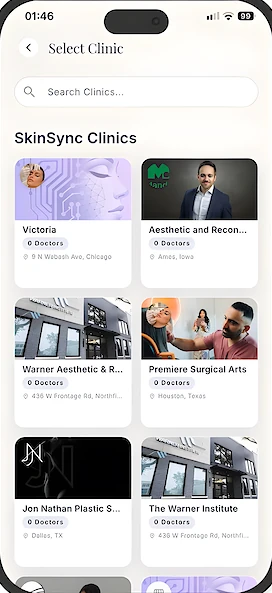
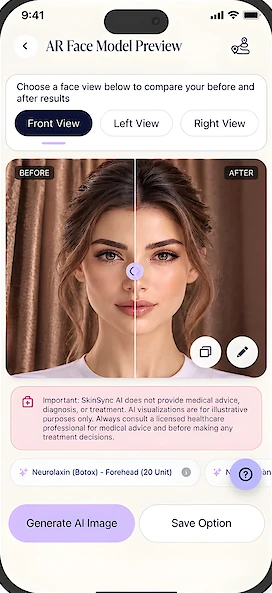
Kybella is not part of the SkinSync AI simulator. In the app you can see simulations of neurotoxin and dermal filler treatments today (laser and energy-based treatments are coming soon), find participating clinics and providers with their availability and pricing, and book a consultation.
- Not simulated: Kybella is not part of the app simulator
- Available now: scan your face and see illustrative neurotoxin and filler simulations from the front and both sides
- Find participating clinics and providers, with availability and pricing
- Book a consultation, in person or virtual, or a treatment directly in the app
- Save your scans and get reminders and aftercare guidance


Simulations are illustrative and do not predict results. The app does not give medical advice; a licensed provider determines appropriate treatment.
Sources
Every medical fact on this page is linked to one of these sources. Reviewed October 30, 2026.
- DailyMed (U.S. National Library of Medicine): KYBELLA (deoxycholic acid) injection, prescribing information and patient information
- U.S. Food and Drug Administration: FDA approves additional information in labeling for Kybella (deoxycholic acid) injection warning of adverse reactions associated with unapproved use
- American Society of Plastic Surgeons: Injection lipolysis
- Frontiers in Endocrinology: The Role of Fat Reducing Agents on Adipocyte Death and Adipose Tissue Inflammation (2022); Current Issues in Molecular Biology: Deoxycholic Acid at the Interface of Bile Acid Metabolism and Adipose Tissue Remodeling: From Endogenous Signaling to Injectable Adipocytolysis (2026)
- American Society of Plastic Surgeons: Cryolipolysis
- U.S. Food and Drug Administration 510(k) database: K193566, CoolSculpting System, indications for use
- American Society of Plastic Surgeons: How much does nonsurgical fat reduction cost?
Related guides
Kybella and CoolSculpting are trademarks of their respective owners. SkinSync AI is not affiliated with or endorsed by these companies.